
Customs Duty in India: BCD, SWS, IGST and Import Duty Calculation | CustomsDesk
CustomsDesk · Article 03
By Dushyant | CustomsDesk | Educational Article
What does an Indian importer actually pay when goods arrive from another country? This beginner-friendly guide explains the legal framework, the main duty components, how they interact, worked calculations, exemptions and selected court decisions.
Reading time: approximately 25–30 minutes. Rates in worked examples are hypothetical unless expressly stated otherwise. This is an educational guide, not a product-specific duty quotation or legal opinion.
In this article
- Introduction
- Legal framework
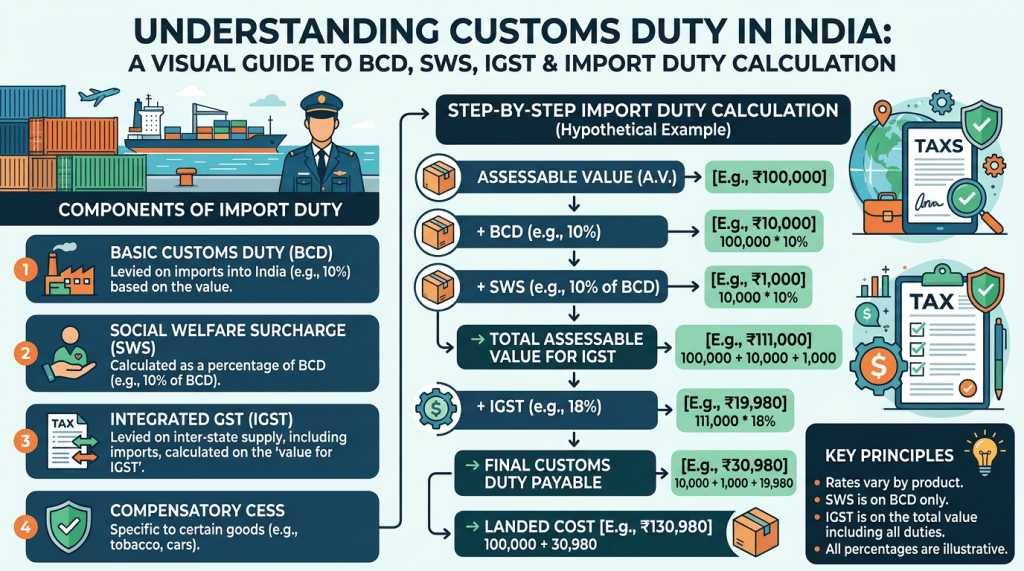
- Duty calculation at a glance
- What is Customs duty?
- Why classification comes first
- Assessable value and exchange rate
- Basic Customs Duty
- Social Welfare Surcharge
- SWS case studies
- IGST on imports
- Complete worked calculation
- Exemptions and concessions
- Other duties
- How to read a judgment
- Common mistakes
- Practical checklist
- FAQs
- Self-test
- Official sources and cases
- Related reading
- Conclusion
1. Introduction: What happens when goods enter India?
Imagine an Indian company importing a machine from Germany. The supplier invoices in US dollars, the machine arrives at an Indian port, and the importer wants to clear it for home consumption. Before clearance, the importer must complete the relevant Customs formalities and pay duties that legally apply, unless an exemption or other relief is available.
Is duty calculated directly on the invoice? How is foreign currency converted? What are BCD, SWS and IGST? Does every product attract the same rate? Can an exemption from one duty affect another? These questions are connected, but each has a separate legal answer.
Import duty is not one universal percentage applied to every product. The outcome depends on classification, assessable value, applicable rates, notifications, exemptions, additional levies and the law in force for the relevant import.
2. First understand the legal framework
| Law or instrument | Why it matters |
|---|---|
| Customs Act, 1962 | Import procedures, assessment, valuation framework and clearance. |
| Customs Tariff Act, 1975 | Tariff classification and statutory provisions for duties on imported goods. |
| First Schedule to the Customs Tariff Act | Tariff items and standard rates, subject to applicable law. |
| Finance Act, 2018, Section 110 | Statutory framework for Social Welfare Surcharge. |
| IGST Act, 2017, read with Customs Tariff Act | Framework for IGST on imported goods. |
| Exemption notifications and amendments | May prescribe full or partial exemptions, concessions and conditions. |
Use primary sources: India Code, CBIC Tax Information Portal, India Budget and ICEGATE.
Important: A tariff rate is not always the final effective rate. An exemption or concession may change the amount, but only where its terms and conditions are met.
3. Duty calculation at a glance
- Identify the goods and determine the correct tariff classification.
- Determine assessable value under the applicable valuation provisions.
- Identify the applicable BCD rate and exemptions.
- Calculate SWS on the statutory base, if applicable.
- Determine the IGST rate and statutory calculation base.
- Check other duties, cesses, trade-remedy measures or special levies.
- Verify dates, notification conditions and supporting documents.
Classification identifies tariff treatment; valuation determines the value used for assessment; the relevant provisions determine which duties apply.
4. What is Customs duty?
Customs duty is a duty imposed under Customs legislation on imported goods and, in specified circumstances, exported goods. This guide focuses on imports. An importer needs to establish the goods, classification, assessable value, applicable duty provisions and availability of exemptions.
4.1 Customs duty is not the purchase price
If an invoice is equivalent to ₹1,00,000, that amount does not automatically become the final assessable value. Valuation provisions may require additions or adjustments depending on the transaction. Correct assessment begins with legally correct inputs, not just arithmetic.
5. Why classification comes first
Goods are classified under the Customs Tariff using the relevant headings, subheadings and tariff items. Classification follows the legal text, product characteristics and applicable interpretative rules. It is not simply a matter of choosing the heading with the lowest rate.
If you are new to classification, read Customs Classification Explained: Understanding HSN, Tariff Headings and GIR 1. It explains how goods are classified before the applicable duty rate is identified.
Two products with the same assessable value can attract different duties because their classifications or applicable notifications differ.
Practical rule: Do not choose a tariff heading from a marketing name alone. Confirm the product’s technical characteristics and the legal tariff wording.
6. Assessable value and exchange rate
Assessable value is the value on which relevant Customs duties are calculated. It is determined under the applicable valuation provisions, including Section 14 of the Customs Act, 1962 and the Customs Valuation (Determination of Value of Imported Goods) Rules, 2007, as applicable.
It may not equal the supplier’s invoice amount. Valuation rules may require specified additions, and the declared transaction value may need examination under the rules.
Before calculating duty, read our Customs Valuation in India: Section 14, Transaction Value, Exchange Rate and Valuation Rules Explained for transaction value, valuation adjustments and exchange-rate treatment.
6.1 Why the exchange rate matters
Foreign currency conversion for Customs purposes follows the statutory framework and the applicable rate determined under Section 14 and relevant notifications. Do not automatically substitute a bank’s spot rate or a payment app’s rate. Verify the rate and relevant date for the Bill of Entry concerned.
Keep the concepts separate: the exchange rate converts foreign currency for Customs purposes; valuation rules determine assessable value; tariff provisions determine duty treatment.
7. Basic Customs Duty (BCD)
7.1 What is BCD?
Basic Customs Duty is a principal Customs duty imposed under the Customs Tariff Act, 1975, read with the applicable tariff item and legal provisions. The effective rate depends on classification, tariff provisions and any exemption or concession.
7.2 Simple example
Assume assessable value is ₹1,00,000 and the illustrative BCD rate is 10%.
BCD = Assessable Value × Applicable Rate
₹1,00,000 × 10% = ₹10,000
The 10% rate is hypothetical, not a claim about the current rate for any specific product.
7.3 How to identify the rate
- Determine the correct classification.
- Locate the tariff item in the First Schedule.
- Read the tariff rate and relevant notes.
- Check current exemption and concessional notifications.
- Verify that goods and importer meet notification conditions.
- Check whether other duties or special measures apply.
8. Social Welfare Surcharge (SWS)
8.1 What is SWS?
SWS was introduced under Section 110 of the Finance Act, 2018. The provision states that it is calculated at 10% on the aggregate of specified duties, taxes and cesses levied and collected under Section 12 of the Customs Act and specified sums chargeable under other laws, subject to statutory exclusions and applicable notifications.
That wording matters. It is unsafe to describe SWS in every situation as 10% of assessable value or to reduce the legal base to “always 10% of BCD”. The actual base must be determined from Section 110, applicable notifications and the facts.
For a simplified example where the relevant SWS base is BCD, assume BCD of ₹10,000 and SWS at 10%:
Illustrative SWS = ₹10,000 × 10% = ₹1,000
The example states its assumption. In a real assessment, apply the statutory base and exclusions relevant to the goods and import.
8.2 Why SWS matters
SWS is a separate levy. Its base, exclusions and any exemption must be examined. An exemption or credit mechanism affecting one duty does not automatically resolve every question about another levy.
9. SWS case studies: statutory wording and facts matter
The following decisions concern particular contexts, including SWS where BCD was treated as nil under specified schemes or exemptions. They should not be read as universal rulings for every product or every BCD exemption.
Case 1: La Tim Metal & Industries Ltd. v. Union of India
Forum/date: Bombay High Court, 15 November 2022.
Issue: The petitioner challenged notional SWS collection on imports cleared with nil BCD in the context of Notification No. 24/2015-Customs and duty-credit scrip arrangements.
Decision: In the circumstances before it, the Court held that where SWS was payable at 10% on BCD but the relevant BCD was nil, SWS was also to be computed as nil. It directed re-credit of the notional SWS amount in duty-credit scrips as set out in its order.
Practical lesson: Check the statute, notification and relevant circular before applying a surcharge to a notional base.
Read the judgment. See also the earlier connected order in La Tim Sourcing (India) Pvt. Ltd., Bombay High Court, 10 August 2022.
Case 2: Gemini Edibles and Fats India Pvt. Ltd. v. Union of India
Forum/date: Madras High Court Division Bench, 10 May 2024.
Issue: The litigation concerned MEIS/SEIS duty-credit scrips, SWS and the relationship between the relevant exemption notifications and the obligation to pay SWS.
Why it matters: Exemption from a specified duty and permission to discharge another duty through a credit instrument are distinct legal questions. Read the Division Bench decision, relevant statutory wording and operative directions, not only the earlier single-judge order.
Scope: Do not reduce this litigation to a universal statement that SWS is always payable or never payable.
Read the Division Bench judgment dated 10 May 2024. Earlier proceedings.
Case 3: Reliance Life Sciences Pvt. Ltd. v. Commissioner of Customs
Forum/date: CESTAT, Mumbai, 27 February 2024.
Context: The appeals considered SWS in the context of duty-credit scrips, the relevant Customs circular and judicial decisions addressing whether SWS was nil when the aggregate duties forming its calculation base were zero.
Practical lesson: CESTAT considered the Ministry of Finance clarification and relevant High Court decisions. Identify the circular applicable to the period and examine how the Tribunal treated the authorities cited by both sides.
9.1 What should a reader take away?
- Identify the exact scheme or exemption notification.
- Read the statutory text and relevant CBIC circular, including date and scope.
- Distinguish nil effective duty from duty payable but discharged through a credit instrument.
- Read the final order and later appellate or review decisions.
- Do not assume a ruling concerning one notification automatically applies to another import.
These are selected examples, not an exhaustive survey of all CESTAT, High Court and Supreme Court decisions. Check full judgments and subsequent history before relying on a case in a live assessment.
10. IGST on imported goods
10.1 What is IGST?
IGST forms part of India’s GST framework. Imported goods are subject to IGST under relevant provisions, including the Customs Tariff Act read with the IGST Act. Section 3(8) of the Customs Tariff Act provides the relevant valuation mechanism for IGST on imported goods.
In the usual calculation, the assessable value is increased by applicable Customs duties and other amounts that the statute requires to be included. For the simplified examples here, assume the IGST base is assessable value plus BCD plus SWS. This is an explicit example assumption, not a substitute for checking the statutory base in a real case.
10.2 Simple example
Assume assessable value ₹1,00,000; BCD ₹10,000; SWS ₹1,000; illustrative IGST rate 18%.
Assumed IGST base = ₹1,00,000 + ₹10,000 + ₹1,000 = ₹1,11,000
IGST = ₹1,11,000 × 18% = ₹19,980
| Component | Illustrative amount |
|---|---|
| BCD | ₹10,000 |
| SWS | ₹1,000 |
| IGST | ₹19,980 |
| Total of these components | ₹30,980 |
The total excludes other applicable levies, fees or charges. Rates are hypothetical, not product-specific current rates.
11. Complete worked calculation: importing a machine
Assume an Indian company imports a machine with assessable value already determined as ₹5,00,000. For teaching purposes, assume BCD 7.5%, SWS 10% of BCD for this simplified example, and IGST 18% on assessable value plus BCD plus SWS. Assume no exemption or other levy applies.
Step 1: BCD
₹5,00,000 × 7.5% = ₹37,500
Step 2: SWS
₹37,500 × 10% = ₹3,750
Step 3: Assumed IGST base
₹5,00,000 + ₹37,500 + ₹3,750 = ₹5,41,250
Step 4: IGST
₹5,41,250 × 18% = ₹97,425
Step 5: Add the components
| Component | Amount |
|---|---|
| BCD | ₹37,500 |
| SWS | ₹3,750 |
| IGST | ₹97,425 |
| Total illustrative duties | ₹1,38,675 |
In this hypothetical example, listed duties total 27.735% of the assumed assessable value. That is not a universal import-duty rate. Different rates, exemptions, cesses or other duties change the result.
The assessable value is assumed to have already been determined. See our Customs Valuation Guide for the preceding valuation steps.
11.1 What if BCD is exempted?
Verify that the exemption applies, that its conditions are met, what effect it has on SWS, how IGST must be calculated and whether another levy remains payable. Do not simply change BCD to zero and stop analysing.
12. Exemptions and concessional rates
A Customs exemption notification may reduce or remove a specified duty for specified goods or imports, subject to its wording and conditions. Conditions may relate to tariff item, importer, use, authorisation or scheme, documents, origin or relevant date.
12.1 Read the actual notification
- Which duty is exempted or reduced?
- Is it a full exemption or a partial/concessional rate?
- Which goods and tariff items are covered?
- Are certificates, end-use conditions or procedures prescribed?
- Does the exemption affect another levy, or must that levy be analysed separately?
- Was the notification in force and applicable on the relevant date?
Do not overgeneralise: Exemption from BCD does not automatically exempt every other duty. Equally, do not assume a surcharge is payable on a notional amount without examining its statutory base and relevant circulars or judgments.
13. Other duties and special measures
BCD, SWS and IGST are important components, but not an exhaustive list of all possible levies. Depending on product, origin, exporter, trade conditions and law in force, imports may also be affected by:
- Agriculture Infrastructure and Development Cess (AIDC);
- Anti-dumping duty;
- Safeguard duty;
- Countervailing duty under the applicable trade-remedy framework; or
- Another statutory levy or special measure.
These are not added mechanically to every import. Check the relevant notification, product and country/exporter scope, effective period, exemptions and interaction with other duty bases.
14. How to read a Customs judgment properly
- Facts: What goods were imported, under what scheme and during which period?
- Issue: What exact question had to be decided?
- Statutory text: Which section, rule, tariff entry, notification or circular applied at the time?
- Arguments: What did the importer and department contend?
- Reasoning: Why were those arguments accepted or rejected?
- Holding and relief: What did the final order actually direct?
- Procedural history: Was there an appeal, review, stay, reversal or later clarification?
- Practical scope: Which later situations are comparable and which are distinguishable?
Judicial hierarchy matters. A Supreme Court ruling has a different precedential position from a High Court or Tribunal decision. When decisions appear inconsistent, examine statutory context, bench, dates and subsequent history rather than presenting a false universal rule.
15. Common mistakes made by beginners
- Applying one flat percentage to every import. Rates and notifications depend on goods and law.
- Treating invoice value as assessable value. Apply valuation provisions.
- Assuming SWS is always 10% of assessable value. Read Section 110 and its base/exclusions.
- Assuming SWS is always only 10% of BCD. That shorthand can omit wider statutory wording.
- Calculating IGST only on invoice value. Check Section 3(8) of the Customs Tariff Act and applicable statutory base.
- Assuming an exemption covers every duty. Read the exact notification and conditions.
- Using an old rate. Verify the relevant date and amendments.
- Quoting a case without the final order. Read the judgment and later history.
- Choosing a heading because it is cheaper. Classification must follow tariff law.
16. Practical checklist before calculating import duty
- ☐ Correct tariff classification established.
- ☐ Assessable value determined under applicable valuation rules.
- ☐ Currency conversion rate and relevant date verified.
- ☐ BCD tariff rate checked.
- ☐ Current exemptions and concessional notifications checked.
- ☐ SWS base, exclusions and rate verified.
- ☐ IGST rate and statutory calculation base verified.
- ☐ AIDC, anti-dumping, safeguard or other relevant levies checked.
- ☐ Conditions, documents and effective dates checked.
- ☐ Relevant judgments and circulars read in context.
- ☐ Calculation and sources documented.
This is a learning aid, not a replacement for the statutory assessment requirements of a particular import.
17. Frequently asked questions
Q1. Is BCD always payable?
No. The amount depends on tariff provisions, effective rate and applicable exemptions.
Q2. Is SWS always 10% of assessable value?
No. Section 110 specifies a calculation base and exclusions. Apply the actual statutory wording.
Q3. Is IGST always 18%?
No. The rate depends on product classification and relevant GST and Customs provisions.
Q4. If BCD is nil, is SWS automatically nil?
Do not apply that conclusion universally. La Tim Metal addressed a particular context. Read the judgment, applicable circular and facts before applying it elsewhere.
Q5. Does BCD exemption automatically exempt IGST?
Not necessarily. Examine the exemption’s scope and IGST provisions separately.
Q6. Can an importer choose a lower rate found online?
No. The rate must be supported by classification, current tariff provisions and notifications.
Q7. Is this a final duty quotation?
No. It is an educational illustration using assumed rates. Real calculations require product-specific facts and current legal verification.
Q8. Where do I start if I do not understand assessable value?
Read our Customs Valuation Guide first.
18. Self-test
- An import has assessable value ₹2,00,000 and illustrative BCD rate 10%. What is BCD?
Answer: ₹20,000. - Under the simplified example where SWS is 10% of BCD, what is SWS on BCD of ₹20,000?
Answer: ₹2,000, assuming that base applies. - Why check the notification before concluding SWS is payable or nil?
Answer: Statutory base, exemptions, scheme conditions and circulars or judgments may affect the outcome. - What must be verified before applying a tariff rate?
Answer: Classification, applicable rate, current notifications and their conditions. - Why may invoice amount differ from assessable value?
Answer: Valuation provisions may require additions or adjustments depending on the transaction.
19. Official sources and further research
Prefer primary legal sources. Case databases can help locate decisions, but use official court copies wherever available and check the full text.
- India Code — legislation.
- CBIC Tax Information Portal — Customs Acts, rules and notifications.
- CBIC: Social Welfare Surcharge statutory text — Section 110, Finance Act, 2018.
- India Budget — Finance Acts and tariff amendments.
- ICEGATE — Customs services and tariff-related resources.
- La Tim Metal & Industries Ltd. v. Union of India — Bombay High Court, 15 November 2022.
- La Tim Sourcing (India) Pvt. Ltd. v. Union of India — Bombay High Court, 10 August 2022.
- Gemini Edibles and Fats India Pvt. Ltd. v. Union of India — Madras High Court Division Bench, 10 May 2024.
- Reliance Life Sciences Pvt. Ltd. v. Commissioner of Customs — CESTAT Mumbai, 27 February 2024.
Research note: These are selected examples, not an exhaustive survey of all CESTAT, High Court and Supreme Court jurisprudence. Before relying on a judgment, check the complete decision, subsequent appeals or review proceedings, current statutory text and notifications applicable to the relevant period.
20. Related reading
These CustomsDesk guides cover the two steps that come before duty calculation:
- Customs Classification Explained: Understanding HSN, Tariff Headings and GIR 1
Learn how imported goods are classified under the Customs Tariff. - Customs Valuation in India: Section 14, Transaction Value, Exchange Rate and Valuation Rules Explained
Understand how assessable value is determined before Customs duty is calculated.
The learning sequence is Classification → Valuation → Duty Calculation. Each article answers a different question and together they build a foundation for studying Indian import Customs assessment.
21. Conclusion
Customs duty calculation becomes easier once the legal steps are separated. First determine the correct classification. Then establish assessable value. Identify the applicable BCD rate and any exemption. Calculate SWS and IGST under their respective statutory provisions. Finally, check whether another levy or special measure applies.
A correct Customs duty calculation is a legal calculation, not merely an arithmetic exercise. The arithmetic may be simple, but the result is only as reliable as the classification, valuation, rates, notifications and legal interpretation behind it.
About the Author
Dushyant is the creator of CustomsDesk, an educational platform focused on Indian Customs law, tariff classification, import procedures and related legal developments. CustomsDesk aims to make complex legal and regulatory concepts easier to understand through structured explanations, practical examples and references to legal sources.
Website: CustomsDesk
Disclaimer: This article is for educational and informational purposes only. It is not legal, tax or Customs-clearance advice. Rates, notifications and judicial interpretations may change. Verify legislation and applicable official notifications before relying on a calculation or applying a case to a specific import.
© 2026 CustomsDesk. All rights reserved.


Leave a Reply