
By Dushyant | CustomsDesk
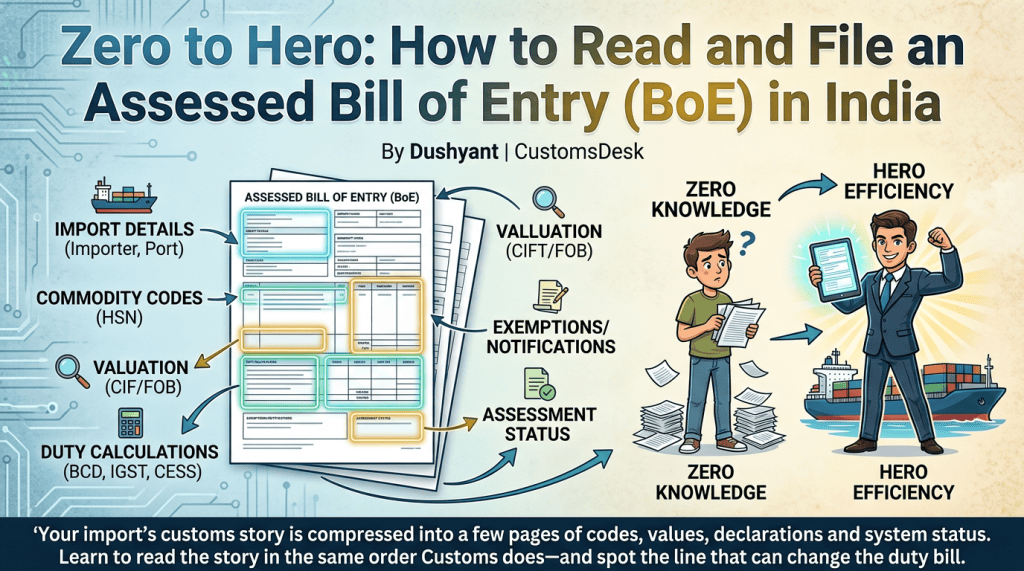
Your import’s customs story is compressed into a few pages of codes, values, declarations and system status. Learn to read the story in the same order Customs does—and spot the line that can change the duty bill.
Sample note: the Ahmedabad PDF contains a seven-page assessed home-consumption BoE at PDF pages 42–48 (the BoE itself labels these pages 1–7). Earlier pages contain a Section 124 show-cause notice and annexures. The article describes the BoE fields and visible statuses while masking commercial identifiers. “ASSESSED” does not itself prove payment, examination completion, OOC or physical delivery.
Index
- The 60-second reading method
- What an assessed BoE is
- What the Ahmedabad PDF actually shows
- Field-by-field guide, in declaration order
- Self-assessment, reassessment and speaking order
- How to read the duty calculation
- Payment, clearance and Out of Charge
- Where the data comes from
- Common mistakes and red flags
- How to file, retrieve and download a BoE
- What courts and CESTAT say
- Importer’s final checklist
- FAQs
- Official sources and related CustomsDesk reading
1. The 60-second reading method
Think of the Bill of Entry as a chain, not a receipt. First confirm who imported what, under which invoice and transport document, and at which port. Then test classification, origin, quantity and assessable value. Only after those facts make sense should you read exemptions and duty arithmetic. Finish by checking whether the entry is self-assessed, reassessed, paid, and actually given Out of Charge.
Keep the invoice, purchase order/contract, packing list, bill of lading or air waybill, freight and insurance evidence, certificate of origin, licence/permit and product literature alongside the BoE. The BoE is a declaration supported by those records; it is not a substitute for them.
2. What an assessed BoE is
A Bill of Entry is the import entry filed under Section 46 of the Customs Act, 1962, for home consumption or warehousing. Under Section 17, the importer self-assesses duty; Customs may verify the declaration and reassess where the self-assessment is incorrect. A BoE can have multiple invoices and item lines. One header-level value does not tell the full story: classification, quantity, valuation, exemption and duty are generally tested line by line.
“Assessed copy” usually means the processed electronic copy showing the filed declaration and resulting assessment information. It is not necessarily proof that duty has been paid, other regulatory conditions met, or goods released. Read assessment, payment record and OOC status separately.
3. The Ahmedabad assessed BoE: what we can see
The supplied Ahmedabad Customs Zone PDF is a multi-document file. Its first pages are a Section 124 show-cause notice; the assessed home-consumption BoE is at physical PDF pages 42–48, printed as pages 1–7 of the BoE. The BoE header names ICD Sabarmati, Ahmedabad, shows BoE type H and first-copy status, and carries a diagonal “ASSESSED” watermark across the pages. The PDF does not state that the BoE is anonymised: the source includes importer, broker, IEC/GST, invoice, container, seal, IGM and document references. This article masks those identifiers rather than republishing them.
What the line tells us: one invoice, one item and four containers; the goods are described as stainless steel scrap 409 grade for melting purpose, declared under CTH 72042190, quantity 106,080 kg at an invoiced unit price of USD 0.50/kg. The invoice amount shown is USD 53,040; invoice terms show CIF and payment terms DP. The valuation panel shows Rule 4 (transaction value), related-party “No” and assessable value ₹4,720,560. The duty summary shows IGST and total duty/amount of about ₹849,701. These are transcribed from the displayed copy, not independently recalculated or endorsed as legally correct. Currency conversion, duty rows, notifications and any subsequent proceedings must be checked against the complete file and law applicable on the relevant date.
Crucially, the printout includes a Customs RMS examination order directing checks, while examination report and OOC No./OOC Date fields are blank on the displayed pages. Therefore “ASSESSED” on this copy does not establish that examination was completed, duty payment cleared, OOC granted or goods physically delivered. The first pages of the same PDF later show a notice alleging misdescription/misclassification; a notice contains allegations, not a final finding. Do not treat the assessed BoE or notice alone as a judgment on that dispute.
The remaining sections walk through the actual printed BoE in the order it appears, explain the visible labels and connect each to the supporting record and its assessment impact. Because the sample contains commercial identifiers, redact them if reproducing screenshots on a public site.
4. Read the assessed copy in its printed order
Physical pages 42–48 of the PDF are pages 1–7 of the BoE. The labels below follow those pages. A few acronyms are explained in the BoE’s own glossary; where a label is abbreviated, consult the current ICEGATE message format. The same print layout can vary for other entry types.
4.1 Header and Part I — Bill of Entry Summary (printed page 1)
The top banner identifies Indian Customs, the port, “Bill of Entry for Home Consumption,” BoE number/date/type, port code, IEC/branch, GSTIN/type, Customs Broker code, copy status and a QR code. The sample is type H, a land-mode entry, with one invoice and item, four containers/packages as indicated in the header, and gross weight 106,080 kg. Protect identifiers when sharing a copy.
Part I is ordered as follows:
- A. Status: BE Status, Mode, DEF BE (deferred payment), KACHA, Section 48, re-import, advance BE, assessment, examination, HSS, first-check and provisional/final flags. These are coded workflow indicators. In this sample the entry is marked First Copy, Land, assessment Y, examination N and provisional/final F, among other N flags. Do not infer final release from one flag.
- Country of Origin, Country of Consignment, Port of Loading and Port of Shipment: the sample shows UAE as origin and consignment country and Jebel Ali for loading/shipment. Verify origin against production/origin evidence and any preference claim; country of consignment and port do not establish origin by themselves.
- B. Declarant: Importer name/address, Customs Broker name, AEO code and UCR (Unique Customs Reference). Reconcile the importer/branch with IEC and commercial documents; the broker’s presence does not transfer the importer’s declaration responsibility.
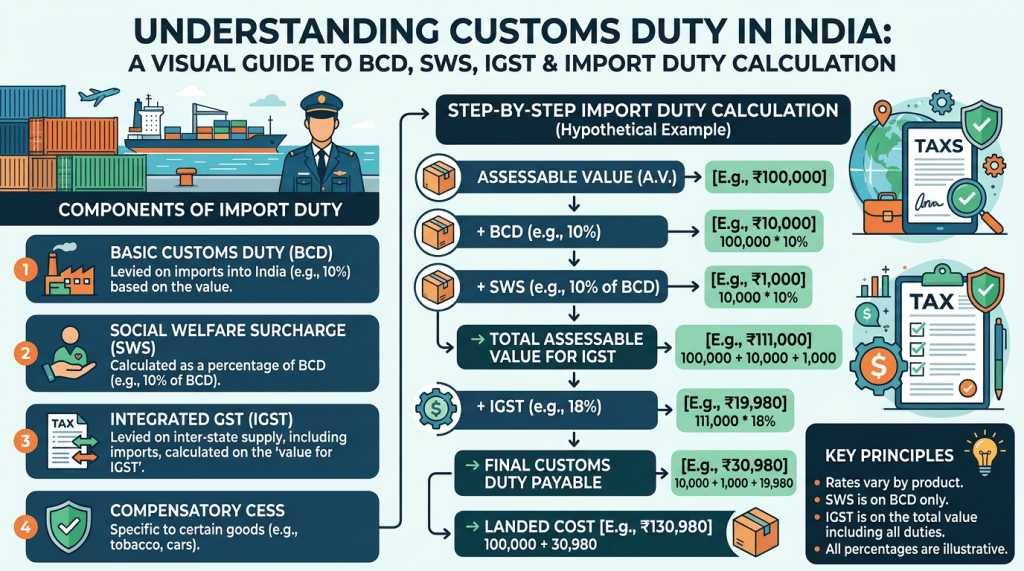
- C. Duty Summary: BCD, ACD, SWS, NCCD, ADD, CVD, IGST, cess and other labelled components, followed by assessable value, total duty, interest, penalty, fine and total amount. The sample prints assessable value ₹4,720,560 and IGST/total duty/total amount about ₹849,701. Confirm actual paid amount separately against the challan.
- D. Manifest Details: IGM number/date, inward date, gateway IGM, gateway manifest date, MAWB/BL number/date, HAWB number/date, packages and gross weight. These should reconcile with carrier/manifest and transport documents; mismatches can prevent cargo/entry matching.
- E. Bond Details and warehouse details: bond number, port, bond code, debit amount and BG amount, plus warehouse entry references where relevant. Blank bond fields are normal for a direct home-consumption entry; do not fill them with unrelated references.
- F. Payment Details: serial number, challan number, paid-on date and amount. The copy shows a challan reference and ₹849,701 but the displayed paid-on field is blank. Treat this as a cue to verify payment status/receipt in ICEGATE, not as proof of payment.
- G. Processing Details: event, date, time and exchange rate. The sample records submission and assessment timestamps and shows USD=₹89; check the applicable notified exchange rate for the legal date and the official record.
- H. Invoice Summary: invoice serial, invoice number, invoice amount and currency; link each to Part II.
- I. OOC and J. Container Details: OOC number/date are blank in this copy. Container serial, LCL/FCL, truck, seal and container numbers should match transport and delivery records. OOC blank means this printout does not itself show an OOC order.
Where data comes from: IEC/ICEGATE profile, bill of lading/airway bill, IGM, arrival notice, invoice, broker authorisation and system events. Common traps: confusing “assessment Y” with completed examination or OOC; treating challan number as proof it was paid; or mixing origin with dispatch location.
4.2 Part II — Invoice & Valuation Details (printed page 2)
The invoice block records serial, invoice number/date, purchase-order number/date, letter-of-credit number/date and contract number/date. In the sample, invoice serial 1 and invoice date are present; PO, LC and contract references appear blank. Buyer, seller, supplier and third-party addresses follow. These should agree with the purchase contract and invoice; a mismatch can affect importer identity, transaction value, related-party review or audit trail.
The valuation block then shows invoice value, freight, insurance, HSS, loading, commission, payment terms, valuation method, related-party flag and SVB references. The sample shows USD 53,040, payment terms DP, method “Rule 4 (Transaction Value),” related-party “No,” CIF terms, and blank freight/insurance/addition rows. “Blank” is not proof that no cost existed: confirm the commercial terms and supporting records. The costs-and-services table includes commission/brokerage, cost of container, cost of packing, handling charges, goods and services input cost, document charges, country-of-origin certificate, royalty/licence fees, loading/unloading, warranty, other costs and miscellaneous charge. Each is a valuation check, not an automatic add-on; apply Section 14 and the Valuation Rules to the facts.
At the bottom, Part II repeats item serial, CTH, description, unit price, quantity, UQC and amount. The visible line shows CTH 72042190, stainless steel scrap 409 grade for melting purpose, unit price USD 0.50, quantity 106,080 KGS and amount USD 53,040. The invoice amount and item extension agree arithmetically (0.50 × 106,080); the customs assessable value is a separate rupee figure. Confirm the exchange rate and any additions/exclusions. For valuation context, read CustomsDesk’s Section 14 valuation guide and duty calculation explainer.
4.3 Part III — Duties (printed page 3)
Part III repeats the header and lays out item attributes in columns: invoice serial, item serial, CTH, CETH, item description, food-safety/standards flag (FS), plant-quarantine flag (PQ), drug-control flag (DC), wildlife-control flag (WC), animal-quarantine flag (AQ), UPI (unit price invoiced), commercial quantity, commercial UQC, standard quantity, standard UQC, scheme code, standard/product and RSP/other flags, re-import, provisional assessment and end-use. The printed glossary explains several agency abbreviations. Verify any “N” compliance flag against the product and applicable agency rules; it is not a substitute for an approval that is legally required.
For the sample line, the visible CTH is 72042190 and description is stainless steel scrap 409 grade for melting purpose. Quantity and standard quantity both show 106,080 KGS; assessable value shows ₹4,720,560. The notification/duty grid gives component-wise notification number, serial number, rate, amount and duty-foregone fields for BCD, IGST, cess and other duties. Read every row; a zero rate/amount in one field does not mean all duty is nil. The summary on Part I shows IGST/total duty around ₹849,701. For a line-by-line explanation of BCD, SWS and IGST, see the CustomsDesk import-duty explainer.
Classification issue to notice: the BoE declares CTH 72042190 for the described scrap; page 1 of the attached notice later alleges that the description/classification is wrong. That is the department’s allegation in a notice, not a final adjudicated conclusion. Classification depends on the goods’ objective characteristics, tariff text and evidence. Read CustomsDesk’s GIR 1 and tariff-classification guide before drawing any conclusion.
4.4 Part IV — Additional Details (printed page 4)
This page collects conditional/scheme-specific particulars, not another basic invoice summary. In order, it has: A. SVB Details (invoice/item, reference/date, port code, lab, preceding/following references and load date); B. Previous BEs (prior BoE number/date, port, unit price and currency); C. Re-import after export (notification, shipping bill, export/invoice and port references); D. Item Manufacturer/Producer/Grower Details (type, manufacturer code, source/transit country and address); E. Accessory Status/details; F. Licence Details (licence serial/number/date, code, port, debit value, quantity/UQC and debit duty); G. Scheme Notification and Duty Foregone Details; H. Certificate Details; I. IHS Details; J. Single Window Declaration; K. Constituents; L. Single Window Control; M. Supporting Documents; N. Container Details; and O. Invoice Details.
Blank sections may simply be inapplicable; populated fields must match the relevant licence, certificate, scheme, origin, manufacturer or regulatory document. On the sample page, supporting-document rows identify uploaded records, container rows list four containers/seals, and invoice details repeat one invoice amount/currency. Those identifiers have been omitted here for privacy. Errors in licence debit, scheme conditions or document-to-item mapping can change benefit eligibility or hold clearance.
4.5 Part V — Other Compliances (printed pages 5–6)
The first block is A. Examination Order RMS. The sample’s instruction asks Customs to check container seals, de-stuff and examine cargo, ensure stated FTP/HBP and DGFT conditions, verify a Schedule VIII requirement and verify description, valuation and classification. These are instructions for examination/verification, not findings that the checks were completed. Also compare status flags carefully: the summary and item-level provisional-assessment indicators appear different in this printout. Confirm the live assessed record and any later status/order before interpreting the entry. The following labelled blocks are Examination Order, Examination Instructions, PGA Examination Instructions (agency/status), Compulsory Compliance, AC Remarks, Examination Report and Superintendent Comments. They appear blank in the copy shown. Always read the completed report or later query/assessment record before concluding the RMS instructions were satisfied.
The lower portion displays OOC No. and OOC Date, which are blank in the sample pages. That is why the copy supports “assessed BoE” as marked, but does not by itself establish OOC or physical release. Check the live system record and subsequent documents.
4.6 Part VI — Declaration (printed page 7)
The final page contains declarations tied to invoice/item serials. They address the truth and accuracy of invoice/supporting documents and the BoE; price paid/payable and later price adjustments; whether additional payments such as royalties/licence fees or other consideration exist; and third-party restrictions on disposal/use. The sample also has an authorised signatory/date/place area and names the broker. Read the exact statement and serial it applies to: the importer is making factual and legal declarations, not merely approving data entry.
Compare each declaration to contract terms, side agreements, credit/debit notes, assists, royalty arrangements and supporting records. A post-import price adjustment or later-discovered payment may need disclosure or correction under the applicable law. Retain the submitted signed/electronically authenticated version and source documents.
5. Self-assessment, reassessment and speaking order
Self-assessment is the importer’s statement of duty due on the facts and law. Risk selection may lead to document verification, examination or testing; not every entry is physically examined. Section 17(4) permits reassessment if verification shows the self-assessment is incorrect. Where reassessment differs and the importer has not accepted it in writing, Section 17(5) provides for a speaking order. Keep both filed and assessed versions with the underlying declaration.
If an error is found after assessment, do not assume a refund claim alone will correct it. The statutory route may involve appeal or another prescribed correction/reassessment remedy. Take advice promptly where a limitation period may run.
6. How to read the duty calculation
- Start with item classification and assessable value.
- Verify applicable rate and exemption for relevant date and origin.
- Check each component’s base and arithmetic; one component’s base may include another duty.
- Reconcile item-wise duty to invoice-wise and BoE grand totals.
- Compare with payment challan/receipt; a calculated amount is not proof of payment.
Ask: “If this one input—classification, value, origin, quantity or exemption—changed, which duty lines would move?” This sensitivity check often exposes a mismatch.
7. Payment, clearance and Out of Charge
Keep four milestones separate: filed means the electronic declaration was submitted and received a BoE number; assessed means duty was self-assessed or reassessed; paid means payment was credited against the entry; Out of Charge (OOC) is Customs clearance for home consumption under Section 47, subject to applicable requirements. Payment alone is not OOC; OOC is not physical delivery from the terminal or carrier.
Check latest ICEGATE BoE status, payment confirmation, query/examination requirements and OOC. For warehousing, the original entry and later ex-bond clearance are linked but not interchangeable.
8. Where the data comes from
- Importer/IEC: IEC profile and authorised records.
- Goods, price, currency, parties: invoice, contract/order, catalogue/specification and payment records.
- Packages, weight, container, seal, route: packing list, transport document, carrier/manifest and arrival records.
- Freight, insurance and valuation additions: freight invoice, policy and valuation working.
- Origin/preference: origin evidence and certificate under applicable rules.
- Classification: product facts, tariff text, interpretative rules, notes and relevant decisions.
- Rates/exemptions: Customs Tariff, current notifications and trade-remedy measures.
- Assessment/payment/OOC: ICEGATE/Customs acknowledgements, orders and payment receipts.
ICEGATE’s message specification is a data-format reference, not legal advice. Law and notifications control if a screen label or software default conflicts with them.
9. Common mistakes and red flags
- Wrong IEC branch, importer, port, BoE type or manifest reference.
- Confusing origin, consignment country and shipment port.
- Broad product description unsupported by technical evidence.
- Claiming a concession without meeting every notification condition.
- Omitting valuation additions or counting freight twice.
- Inconsistent units/conversions across invoice, packing list and BoE.
- Missing a certificate, licence, standard or item-specific approval.
- Assuming self-assessment means Customs accepted every position.
- Confusing assessed, paid, OOC and physical delivery.
- Treating refund as a substitute for challenging the assessment.
- Publishing a legal notice as an assessed copy or exposing unredacted details.
10. Rookie’s filing walkthrough: from arrival documents to OOC
Can you file without a Customs Broker? An importer can file directly if it has the required ICEGATE registration/authorisation and can complete the declaration, document, payment and compliance steps. A licensed Customs Broker can also file when authorised. The importer must still give accurate facts and review the submitted BoE. For a first commercial import or goods with licensing, valuation, classification or PGA complexity, consider professional help while staying involved in every declaration.
Before opening the filing form: prepare your file
- Confirm importer access: have the correct IEC and branch details, GSTIN mapping where applicable, ICEGATE user registration and authorised filer details. Complete KYC early, especially for a first-time importer; the Jamnagar notice below points to CBIC Circular 02/2018-Customs.
- Confirm shipment and filing deadline: get the carrier/forwarder’s arrival notice and manifest/IGM details, port code, bill of lading/airway bill, container/seal, packages and weights. A BoE may be filed in advance; statutory timing and late-filing consequences depend on the Act/regulations, entry type and port. File early and check the current port notice rather than assume a single deadline applies everywhere.
- Build a source-document folder: commercial invoice, packing list, purchase order/contract, transport document, freight/insurance, payment evidence, origin certificate, product catalogue/specifications, end-use information, licences/permits, test/analysis certificates and any notification-condition evidence. The exact list depends on the goods.
- Resolve compliance before filing: check import policy and any BIS/QCO, FSSAI, Plant Quarantine, Drug Controller, Legal Metrology, wildlife, EPR/CPCB or other PGA requirement. Some registrations must exist before filing; a BoE cannot cure a missing licence or prohibited import.
- Write the classification and valuation notes: make a short internal worksheet with product composition/function, proposed CTH and why, invoice currency/Incoterm, additions or exclusions, exchange-rate source, exemption notification and condition-by-condition proof. Link to CustomsDesk’s classification guide and valuation guide.
Submit, respond and clear
- Choose the right entry: use home-consumption BoE when clearing for domestic use, or warehousing when goods are to be bonded. Ex-bond is a later clearance entry linked to the warehouse BoE. Do not choose a type merely because it looks familiar.
- Upload supporting documents: use e-Sanchit/ICEGATE as required; preview each document for legibility, choose the correct document code, and link its IRN to the correct BoE/item. Uploading a document without associating it to the entry may leave the assessing officer unable to see it.
- Complete all sections: enter header, parties, invoices, logistics, item descriptions, classification, origin, quantity/UQC, customs value, notifications, duty, scheme/licence and PGA data. Save a draft if needed. Reconcile every field to the source documents and avoid copying a previous BoE without checking the new consignment.
- Authenticate and submit: use the current ICEGATE filing method available for your account (web form or permitted message filing). Review declaration text before digital authentication/submission. Save the acknowledgement, generated BoE number/date and uploaded-document IRNs.
- Track processing: check job/status and email/ICEGATE messages. If a query asks for a specific fact/document, answer that point directly and attach the evidence. Keep the query and reply. Examination instructions are not an examination report; wait for examination completion/agency NOC where required.
- Review assessment: compare self-assessed values and duty to any reassessment. If you disagree, respond with evidence and understand whether you are accepting the revised assessment; request/review the speaking order required by Section 17(5) where applicable.
- Pay and verify release: pay the confirmed amount through the current payment workflow and save the challan/receipt. Then separately verify OOC number/date/status and any PGA/terminal condition. Arrange delivery with the carrier/CFS and keep gate-out records.
- Download and archive: retrieve the processed BoE, status and supporting records through ICEGATE’s authenticated download/enquiry tools. Keep filed copy, assessed copy, query/reassessment, payment, OOC and source documents together.
Official circulars and port notices worth knowing
These examples turn general advice into operational checks. A Public Notice issued by one Customs House is not automatically a pan-India instruction. Confirm that it applies to your port, cargo type and date; use the latest notice if an older one was amended or superseded.
- CBIC / filing timing, with JNCH as a worked example: JNCH Public Notice 29/2024 (13 March 2024) explains the filing timetable under Section 46/Regulation 4 and CBIC Circular 08/2021-Customs for Nhava Sheva, with differing treatment by port and certain consignments. Do not apply its port-specific dates mechanically to an Ahmedabad ICD, airport or another Customs House; check the current deadline for the actual entry.
- Gujarat/Jamnagar — document readiness and query replies: Public Notice 11/CCP/JMR/2025 (7 February 2025) recommends advance filing, legible e-Sanchit uploads, correct document codes and linking IRNs to the BoE; it highlights product write-ups, value support, exemption proof, registrations, KYC for first-time importers and specific query replies. It also says to give reasons and supporting declaration for provisional assessment. Its copy list includes Gujarat Customs Ahmedabad/Kandla/Mundra, but confirm with your actual port/assessment group.
- Gujarat/Mundra — provisional assessment request: Mundra Public Notice 23/2024-25 (5 February 2025) describes the “Prov” field for requesting provisional assessment at filing and the initial Service Centre workflow. Use provisional assessment only for a genuine Section 18 reason, state that reason and verify the current ICEGATE interface; do not toggle it as a way to delay ordinary assessment. This is especially useful when reading the provisional flags in the Ahmedabad specimen.
- Maharashtra/JNCH — correcting an error: Public Notice 13/2024 (23 February 2024) sets out online ICEGATE amendment requests and a Service Centre route at JNCH. It distinguishes automatic handling of specified bill-of-lading detail additions from other amendments requiring proper-officer approval, with process depending on assessment/OOC stage. For another port, check that port’s current amendment workflow under Section 149.
- Tamil Nadu/Chennai — a parallel amendment notice: Chennai Public Notice 17/2024 (26 April 2024) also documents ICEGATE amendment submission and approval paths. It is a useful example of port-level implementation, not a substitute for the relevant port’s latest notice.
For current filing messages and document formats, use the latest ICEGATE Message Filing Guidelines (the page lists BE Message Format 2.27, dated 4 September 2026), the e-Sanchit guides, the ICEGATE portal and its BoE status enquiry guidance. Interface labels can change. Never share passwords or signature credentials. Passenger baggage follows a separate declaration and allowance process and is outside this commercial BoE guide.
11. What courts and CESTAT say
These decisions explain the legal effect of a declaration and assessment; they do not decide the facts or tariff of the Ahmedabad notice. Read the orders and check later law before relying on them.
- ITC Ltd. v. Commissioner of Central Excise, Kolkata-IV, 18 September 2019, (2019) 17 SCC 46; 2019 INSC 1049, Supreme Court. Self-assessment is an assessment order. A refund claim cannot itself operate as an appeal or reassessment; the assessment generally must first be modified through the proper statutory route. Practical lesson: review and challenge an adverse assessment promptly. Official Supreme Court judgment.
- Union of India v. M/s G.S. Chatha Rice Mills, 23 September 2020, (2020) 11 SCC 756; 2020 INSC 561, Supreme Court. For the dispute, the relevant rate was tied to legally completed presentation under Section 46 and the 2018 Regulations—not the later Section 47 clearance date. Retain electronic filing timestamps; do not equate filing, payment and OOC. Official Supreme Court judgment.
- Niraj Silk Mills and connected matters v. Commissioner of Customs (ICD), Patparganj, CUSAA 26/2022 and connected appeals, judgment pronounced 27 November 2024, Delhi High Court. The Court explained the current Sections 17/46/47 scheme and held that an accepted self-assessed BoE is an assessment order; it also addressed importer appeals after enhanced valuation. In the cases before it, the appeals were allowed and impugned CESTAT orders set aside. Its valuation discussion stresses that declared transaction value cannot be rejected without the statutory basis and cogent reasons; NIDB comparisons alone are not a substitute for the Customs Valuation Rules. Practical lesson: retain invoices/contracts and challenge unsupported enhancements through the proper route. Official Delhi High Court judgment.
- CESTAT: The Delhi High Court judgment above discusses the underlying CESTAT rulings in the connected matters. This research did not locate a direct official full-text CESTAT copy for a separate BoE decision suitable for citation, so no standalone CESTAT holding is paraphrased from a secondary database.
12. Importer’s final checklist
- IEC/branch, legal name, port, type and manifest match.
- Invoices and lines map once; quantities, units, weights and values reconcile.
- Description is accurate and classification supported by facts and tariff rules.
- Origin is evidenced; preference claim is valid.
- Valuation additions/exclusions are documented; currency conversion checked.
- Exemption, licence, standard and regulatory conditions are satisfied.
- Queries, reassessment and speaking order reviewed and saved.
- Duty matches challan and payment is confirmed.
- OOC is confirmed separately from payment and terminal delivery.
- BoE, source documents, payment and release records stored together.
13. FAQs
Is an assessed BoE the same as a duty receipt?
No. The BoE records declaration and assessment. Confirm payment from the receipt/challan and release from OOC status/order.
Does every BoE get physically examined?
No. Section 17 provides for risk-based selection and verification. A no-examination route does not make the declaration optional or automatically correct.
Can a rookie file a BoE independently?
In principle, an importer with the required ICEGATE access and authority can file directly, but “rookie-ready” does not mean risk-free. First learn the workflow with a low-risk, straightforward shipment, check product-specific restrictions and port instructions, and have a knowledgeable person review the first filing. A licensed Customs Broker can assist; the importer should still verify every declaration.
What if Customs changes classification or value?
Read the query and duty impact, provide relevant evidence, state whether you accept reassessment, and obtain a reasoned order where required. Check appeal/payment deadlines promptly.
Which pages are the assessed BoE in the Ahmedabad PDF?
The assessed home-consumption BoE is at physical PDF pages 42–48, printed as pages 1–7 of the BoE. Earlier pages contain a Section 124 notice and annexures. This guide uses pages 42–48 and masks the commercial identifiers visible in the specimen.
Is this the same as traveller baggage?
No. Passenger baggage has its own declaration and allowance framework and should have a separate guide.
14. Official sources and related CustomsDesk reading
- Customs Act, 1962 (India Code) — notably Sections 14, 15, 17, 46, 47, 124, 128 and 149.
- CBIC Section 17 and CBIC Section 47.
- ICEGATE Message Filing Guidelines (use the latest published message format) and e-Sanchit guides.
- ICEGATE filing/enquiry portal and BoE status enquiry guidance.
- Ahmedabad Customs Zone PDF — the assessed BoE is at physical PDF pages 42–48; earlier pages contain a Section 124 notice and annexures.
- JNCH Public Notice 29/2024 (port-specific filing timetable example).
- Jamnagar Public Notice 11/CCP/JMR/2025 (document readiness and assessment guidance; copied to Ahmedabad/Kandla/Mundra).
- Mundra Public Notice 23/2024-25 (provisional assessment request workflow).
- JNCH Public Notice 13/2024 (Section 149 amendments) and Chennai Public Notice 17/2024 (port-level amendment workflow example). Verify current notice at your port before relying on an older local procedure.
Related CustomsDesk reading: Customs classification and GIR 1 · Customs valuation under Section 14 · Import duty calculation.
General educational information only. A BoE is transaction-specific; verify current law, tariff, notifications, workflow and deadlines. Not legal or customs-brokerage advice.


Leave a Reply