
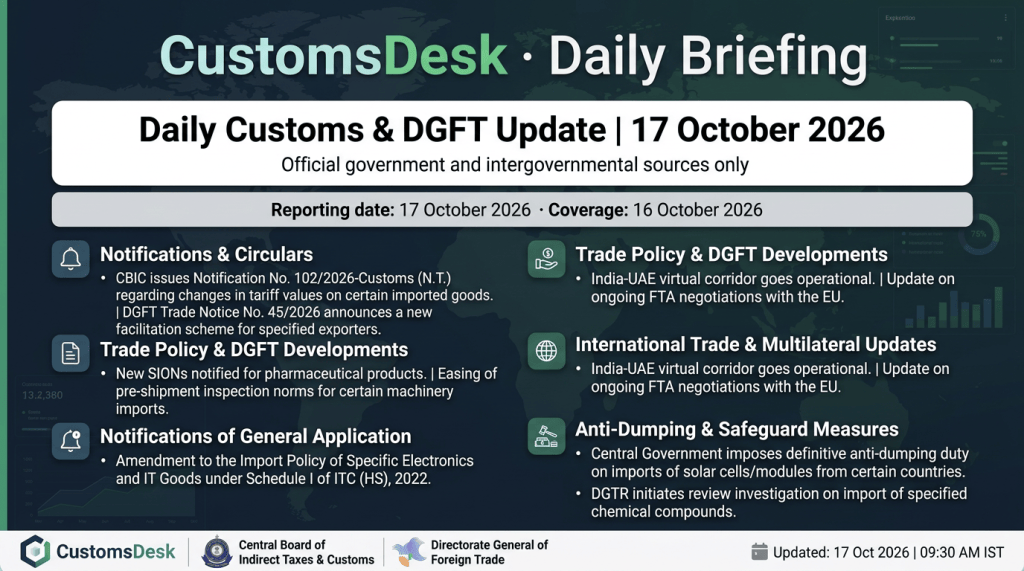
Daily Customs & DGFT Update | 17 October 2026
CustomsDesk · Daily Briefing
Official government and intergovernmental sources only
Reporting date: 17 October 2026 · Coverage: 16 October 2026
This edition covers only developments published, issued or decided on 16 October 2026. Indian regulatory and case-law sections are not padded with older material. Guidance updated on the covered date is identified as guidance, not misrepresented as a new statute or judgment.
1. Customs Notifications
No new Indian Customs notification dated or officially published on 16 October 2026 was verified in the official CBIC and e-Gazette sources checked for this edition. The Finance Ministry Gazette items surfaced in the official listing for that date did not identify a new Customs notification relevant to this roundup.
Official portals checked: CBIC Customs · Government of India e-Gazette
2. DGFT & Foreign Trade Updates
United Kingdom · Published or updated 16 October 2026
UK Carbon Border Adjustment Mechanism (CBAM): New guidance and draft default-values notice
HM Revenue & Customs published new guidance on how importers obtain and report emissions intensity for covered CBAM goods, and on the rates that will apply. HMRC also updated its CBAM records guidance and published a draft Default Values Force of Law Notice. The UK CBAM is scheduled to take effect on 1 January 2027 and covers specified goods in the aluminium, cement, fertiliser, hydrogen, and iron and steel sectors.
The draft default-values notice does not yet have force of law; HMRC says it will take effect when commenced on 1 January 2027. The published rates guidance says rates will be published quarterly from 1 January 2027, rather than establishing a final rate table in this update.
Practical impact for Indian exporters: Indian suppliers selling covered goods to the UK should be ready to provide accurate product and commodity-code details, net weights and verified emissions data to UK customers. UK importers must retain relevant records for six years. Exporters should coordinate with buyers and emissions verifiers well before shipments covered by the new regime.
Official UK government sources:
HMRC: Getting emissions intensity for imported CBAM goods
HMRC: CBAM records to keep
HMRC: CBAM rates guidance
HMRC and HM Treasury: Force-of-law notices and reference document
HMRC: CBAM policy summary
International customs cooperation · 16 October 2026
World Customs Organization highlights customs digitalisation and regional cooperation in the Kyrgyz Republic
The World Customs Organization reported that its Secretary General visited Bishkek for a high-level forum on digital transformation of Customs and a meeting of the Heads of Customs Administrations of the Organization of Turkic States. The WCO highlighted the Kyrgyz Republic’s customs modernisation work, data-driven processes, border infrastructure and regional cooperation, including a pilot simplified customs corridor.
Why it matters: This is an international customs-administration development, not a new tariff rule or a change to Indian Customs law. It reflects the continuing global emphasis on digital customs processes, data exchange and coordinated border controls.
Official source: World Customs Organization: update dated 16 October 2026
India DGFT: No new DGFT notification, public notice, trade notice or policy circular dated 16 October 2026 was verified from the official DGFT portal during this check. Older notices have not been repeated.
Official portal: Directorate General of Foreign Trade
3. Customs Circulars & Public Notices
No new Indian Customs circular, instruction or public notice dated 16 October 2026 was verified from the official CBIC and Customs portals checked for this edition.
Official source: CBIC Customs notifications, circulars and instructions
4. Customs Case Laws
No new relevant Supreme Court, High Court, CESTAT or CAAR judgment or order dated 16 October 2026 was verified from an official judgment or order source during this check. Court pronouncement schedules or cause lists have not been treated as proof that a judgment was delivered, and no case has been added from a private case-summary website.
Official portals: Supreme Court of India judgments · Delhi High Court pronouncements · CESTAT · eCourts judgment search
5. Practical Impact
- Indian exporters to the UK: if you supply aluminium, cement, fertiliser, hydrogen, iron or steel goods within the UK CBAM scope, coordinate with UK buyers on commodity codes, weights and verified emissions information.
- Evidence retention: UK importers are expected to retain relevant CBAM records for six years. Exporters should maintain consistent production and emissions data so customers can substantiate their returns.
- Draft versus law: the UK government states that the draft default-values force-of-law notice has not yet commenced and is intended to take effect on 1 January 2027.
- Indian compliance teams: no new Indian Customs or DGFT legal instrument has been included unless it could be verified for the covered date on an official portal.
Verification note
This is a verified-source roundup, not a guarantee that no other development occurred. It reports only items located on official government or intergovernmental websites during the research check. UK CBAM materials concern a foreign jurisdiction and must not be read as Indian Customs law. Always consult the linked primary document and confirm its current legal status before acting.
CustomsDesk · Educational information on Indian Customs and foreign-trade compliance. Source policy: official government, court or tribunal, and intergovernmental organisation portals only.


Leave a Reply