
By Dushyant | CustomsDesk | Educational Article
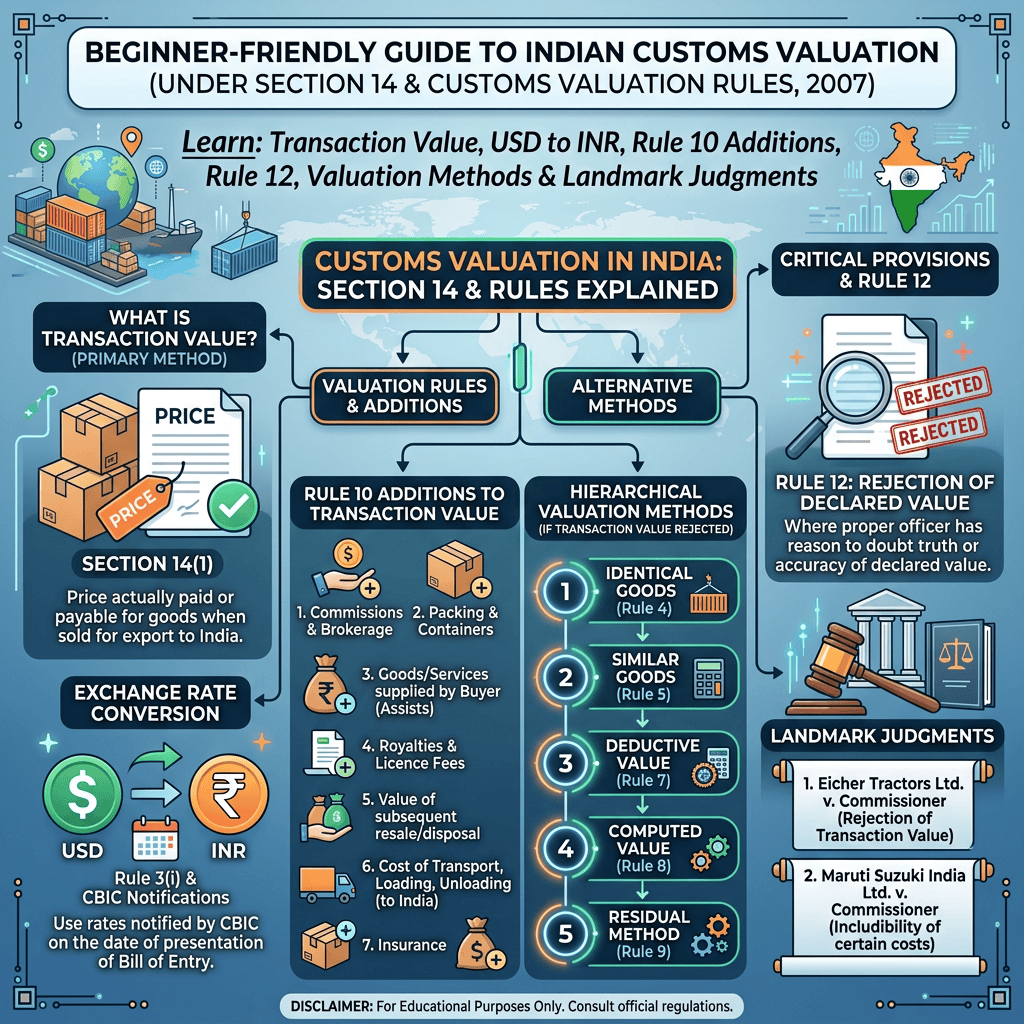
Customs Valuation in India: Section 14, Transaction Value, Exchange Rate & Rules Explained
A beginner-friendly guide to how Indian Customs determines the value of imported goods, when invoice value may be adjusted, how foreign currency is converted into INR, and what important court judgments teach us.
Imagine an Indian business imports a machine from another country. The supplier’s invoice says USD 10,000. Is Customs duty calculated directly on USD 10,000? Does the importer use the bank’s exchange rate? Can Customs add freight, insurance, design costs or royalties? And can an officer reject the invoice merely because another importer paid more for similar goods?
These questions sit at the heart of Customs valuation. This guide starts with the basics and builds step by step, as if we were learning the subject for the first time. The focus is Indian import valuation under Section 14 of the Customs Act, 1962 and the Customs Valuation (Determination of Value of Imported Goods) Rules, 2007.
Table of Contents
- What Is Customs Valuation?
- Why Does Customs Valuation Matter?
- The Legal Framework: Section 14 and the 2007 Rules
- Section 14 Explained in Plain English
- Invoice Value, Transaction Value and Assessable Value
- How to Convert USD into INR for Customs Valuation
- Rule 3: The Transaction Value Method
- When Can Transaction Value Be Accepted?
- Rule 10: Additions to the Price Actually Paid or Payable
- Worked Example: From Invoice to Illustrative Assessable Value
- Rule 12: When Customs Has Reason to Doubt Declared Value
- What Happens After Transaction Value Is Rejected?
- Related-Party Imports: Is the Price Automatically Rejected?
- Documents an Importer Should Keep Ready
- Landmark Case 1: Eicher Tractors Ltd.
- Landmark Case 2: South India Television
- Landmark Case 3: Century Metal Recycling
- Common Customs Valuation Mistakes
- Practical Importer Review Checklist
- Frequently Asked Questions
- Official Sources and Further Reading
- Conclusion
1. What Is Customs Valuation?
Customs valuation is the legal process of determining the value of goods for Customs assessment. Where duty is charged by reference to value, the value used for assessment matters because it forms the base on which the relevant ad valorem duty is calculated.
Suppose a company in India imports a production machine from Germany. The supplier invoices it at EUR 20,000. Customs needs to determine the value under Indian law before the applicable duties can be worked out. The invoice is important evidence, but it is not the end of the legal analysis in every case.
There are three basic questions to keep separate:
- What price did the buyer actually pay or agree to pay? This is the starting point for transaction value.
- What adjustments does the law require? Some costs and services may need to be included if they meet the conditions in the valuation rules.
- Which currency-conversion rate applies? The Customs exchange-rate rule is not necessarily the same as the bank rate used to settle payment.
In simple terms: Customs valuation is not merely “invoice amount × exchange rate”. It is the process of determining the value according to Section 14 and the applicable valuation rules.
2. Why Does Customs Valuation Matter?
Many Customs duties are calculated as a percentage of the assessable value. If the value is incorrect, the duty calculation may also be incorrect. A valuation issue can therefore affect the amount payable, the clearance process, documentation requirements and the handling of a dispute.
Consider two simplified scenarios:
- Scenario A: An importer declares the correct transaction value, applies the appropriate exchange rate and includes the amounts that the law requires.
- Scenario B: An importer overlooks a qualifying addition or uses an incorrect exchange rate. The declared value may then differ from the value required under the law.
Neither scenario can be resolved by looking at one number alone. The supporting documents, nature of the transaction, applicable date, and valuation provisions must be examined.
Customs valuation is also important for compliance and audit. A well-documented valuation file makes it easier to explain why the declared value reflects the transaction and how the calculation was performed.
3. The Legal Framework: Section 14 and the 2007 Rules
The main legal framework for the valuation of imported goods consists of:
- Section 14 of the Customs Act, 1962: Establishes the transaction-value framework and provides for the relevant exchange rate and tariff values where notified.
- Customs Valuation (Determination of Value of Imported Goods) Rules, 2007: Explains how transaction value is tested, adjusted and, where necessary, how value is determined using other methods.
Section 14 and the Rules should be read together. Section 14 provides the statutory foundation, while the Rules explain the detailed method of applying it to different kinds of transactions.
India’s import valuation framework is based on the principles of the WTO Agreement on Customs Valuation, subject to the Indian legislation and rules in force.
Primary sources:
- Section 14, Customs Act, 1962, CBIC Tax Information Portal
- Customs Valuation Rules, 2007, CBIC Tax Information Portal
- Directorate General of Valuation: Brief on Valuation
4. Section 14 Explained in Plain English
Section 14(1) generally provides that the value of imported goods is their transaction value: the price actually paid or payable for goods when sold for export to India for delivery at the time and place of importation, subject to the statutory conditions and the rules.
Let’s unpack the main words.
“Price actually paid or payable”
This refers to the payment made or to be made for the imported goods in the particular transaction. It is not automatically the seller’s catalogue price, a list price in a brochure or the price at which another customer purchased different goods.
“When sold for export to India”
The transaction must fit the legal concept of a sale for export to India. Not every movement of goods across a border necessarily involves a sale that can be valued using the transaction-value method. The Rules provide for situations where the ordinary transaction-value approach cannot be applied.
“For delivery at the time and place of importation”
The transaction is considered in the context specified by the law. Costs such as transportation and insurance may be relevant under Rule 10, depending on the facts and the applicable provisions.
“Subject to the conditions in the rules”
The invoice price is not accepted mechanically in every case. The conditions in Rule 3, the additions in Rule 10, and the procedure in Rule 12 must be considered where relevant.
Section 14 also says that the price is calculated with reference to the exchange rate in force on the date the Bill of Entry is presented under Section 46 for imports. The rate of exchange is the rate determined by the Board or ascertained in the manner directed by the Board.
Do not confuse two different ideas: Section 14(1) addresses transaction value and currency conversion. Section 14(2) separately allows the Board, by notification in the Official Gazette, to fix tariff values for specified classes of goods. Where a tariff value applies, the statutory treatment must be checked rather than assuming the ordinary transaction-value calculation alone controls.
5. Invoice Value, Transaction Value and Assessable Value
These terms are related, but a beginner should not treat them as interchangeable.
Invoice value
The amount written on the supplier’s invoice. For example, the invoice might say USD 10,000. The invoice also needs to be read with the purchase order, contract, credit notes, assists, royalty arrangements and other transaction documents where relevant.
Transaction value
The price actually paid or payable that qualifies under Section 14 and Rule 3. It may be the same as the invoice price, but the legal test and any required adjustments must be considered.
Assessable value
The value determined under the Customs valuation provisions for assessment. It may incorporate the applicable currency conversion and qualifying additions required by the rules. It should not be assumed to equal the invoice value in every case.
| Term | Beginner-friendly meaning | Question to ask |
|---|---|---|
| Invoice value | The amount stated on the seller’s invoice | What amount has the supplier billed? |
| Transaction value | The price recognised under Section 14 and the applicable rules | Does the declared price meet the legal conditions? |
| INR equivalent | The foreign-currency amount converted using the applicable Customs exchange rate | Which notified rate applies on the relevant date? |
| Assessable value | The value determined for Customs assessment under the valuation framework | Are any additions or other valuation rules applicable? |
These concepts help explain why a correct invoice is important but does not remove the need to apply the law.
6. How to Convert USD into INR for Customs Valuation
Import invoices commonly use USD, EUR, GBP, JPY or another foreign currency. For Customs valuation, the applicable rate is governed by Section 14 and the relevant CBIC notification or prescribed mechanism.
For imports, Section 14 refers to the exchange rate in force on the date the Bill of Entry is presented under Section 46. An importer should check the official rate applicable to the currency and date rather than automatically using the exchange rate from a bank statement or online currency tool.
Worked example: converting a USD invoice
Suppose an Indian importer buys a component from a supplier in the United States.
| Particulars | Illustrative amount |
|---|---|
| Commercial invoice value | USD 10,000 |
| Hypothetical Customs exchange rate | ₹86.50 per USD |
| INR equivalent | ₹8,65,000 |
Calculation: USD 10,000 × ₹86.50 = ₹8,65,000.
This calculation gives the INR equivalent of the invoice amount using the hypothetical rate shown. It does not, by itself, establish the final assessable value.
Important: ₹86.50 per USD is an illustrative number, not an assertion about the actual notified rate on any particular date. For a real import, check the CBIC-notified rate applicable to the relevant Bill of Entry date and currency.
Why not use the bank’s rate?
Assume the bank’s commercial rate is ₹87.00 per USD, while the applicable Customs rate for the example is ₹86.50 per USD.
- USD 10,000 × ₹87.00 = ₹8,70,000.
- USD 10,000 × ₹86.50 = ₹8,65,000.
The difference is ₹5,000. The bank rate may be relevant to the actual foreign-exchange transaction, but the Customs valuation calculation must follow the applicable Customs exchange-rate provision.
Practical steps for an importer
- Identify the currency in which the goods are invoiced.
- Confirm the relevant Bill of Entry presentation date.
- Locate the applicable official CBIC Customs exchange-rate notification or prescribed official resource.
- Confirm that the notification covers the currency and the relevant date.
- Calculate the INR equivalent and retain the supporting record with the valuation working.
- Then examine whether Rule 10 or any other valuation provision changes the amount used for assessment.
Primary reference: Section 14, Customs Act, 1962. Always verify the notification in force for the actual transaction; never publish or use an illustrative rate as if it were the official rate.
7. Rule 3: The Transaction Value Method
Rule 3 is central to the valuation of imported goods. Subject to Rule 12, it provides that the value of imported goods is the transaction value adjusted in accordance with Rule 10, where the conditions for acceptance are satisfied.
Think of Rule 3 as the first question in the valuation process: Can the value be determined using the actual transaction, with the adjustments the rules require?
If yes, the transaction-value method is generally the starting point. If not, the Rules provide a sequence of other valuation methods. Customs should not skip that legal structure and simply choose an arbitrary figure.
Example
An Indian importer purchases 100 industrial valves from an overseas supplier for a total price of USD 10,000. The importer has a contract, a commercial invoice and evidence of payment. The buyer and seller are independent, and there is no separate payment that has been overlooked.
These facts may support use of the transaction-value method, but the reviewer must still examine the conditions in Rule 3 and any additions under Rule 10. The existence of an invoice alone is not the entire legal test.
8. When Can Transaction Value Be Accepted?
Rule 3 contains conditions relevant to acceptance of the declared transaction value. In broad terms, the analysis includes restrictions on the buyer’s use or disposition of the goods, conditions or considerations whose value cannot be determined in relation to the goods, proceeds that may accrue to the seller, and the relationship between buyer and seller. The exact wording and exceptions must be read in the Rule itself.
A practical review should ask:
- Is there a sale for export to India?
- Are there restrictions on the buyer’s use or resale of the goods? If so, do they fall within an exception or affect value?
- Is the sale subject to a condition or consideration for which the value cannot be determined in relation to the goods?
- Will any part of the proceeds of a later resale or use accrue to the seller, requiring examination under the Rules?
- Are the buyer and seller related? If so, does the relationship affect acceptance of the value under the applicable provisions?
- Have the required Rule 10 adjustments been made without double counting?
This list is a learning aid, not a substitute for the complete legal text. The facts of each transaction determine which questions are relevant.
9. Rule 10: Additions to the Price Actually Paid or Payable
Rule 10 identifies certain costs and services that must be added to the price actually paid or payable when the specified conditions are met and the amounts are not already included. It is one of the most important practical provisions because the commercial invoice may not capture every amount relevant to Customs valuation.
Potentially relevant categories under Rule 10 include, subject to the detailed conditions of the rule:
- Commissions and brokerage: Certain commissions and brokerage are included, while buying commissions are treated differently.
- Containers and packing: Costs are included where the rule so requires.
- Assists: Certain goods or services supplied directly or indirectly by the buyer, free of charge or at reduced cost, for use in connection with production or sale for export may require an appropriate allocation.
- Royalties and licence fees: These may be included where the applicable conditions are satisfied, including the relevant connection with the imported goods and sale.
- Proceeds: Certain proceeds of subsequent resale, disposal or use that accrue to the seller may need to be included.
- Transport and related costs: Transportation, loading, unloading, handling and insurance may be relevant to the extent and in the manner specified in the rule.
What is an “assist”?
In everyday language, an assist is something the buyer provides to help the overseas supplier produce the goods. Depending on the facts, it may be a material, component, tool, mould, engineering work, design work or another item or service covered by Rule 10.
Example: An Indian buyer supplies a specialised mould to a foreign manufacturer for use in producing parts that will be imported into India. If the mould and its value fall within the conditions of Rule 10, the appropriate value may have to be allocated and added. The amount and allocation method depend on the facts and the rule; it should not be guessed.
What about freight and insurance?
Freight and insurance are not merely accounting labels. Their Customs treatment depends on the relevant legal provisions, the terms of the transaction and the applicable version of Rule 10. Review the documents and the rule instead of adding the same amount twice or assuming every separately billed expense has identical treatment.
Rule 10 is not a blanket addition rule
An expense should not be added just because it exists. The expense must fit the legal category and conditions. Similarly, an importer should not omit an amount simply because it appears in a separate invoice or is paid to a third party.
Rule 10 takeaway: Identify the expense, find the exact clause, check the conditions, confirm whether it is already included, and document the calculation.
Official reference: Customs Valuation Rules, 2007.
10. Worked Example: From Invoice to Illustrative Assessable Value
Let’s combine the ideas. This is a teaching example, not a calculation for a real import.
| Step | Particulars | Illustrative amount |
|---|---|---|
| 1 | Supplier invoice | USD 10,000 |
| 2 | Hypothetical Customs exchange rate | ₹86.50 per USD |
| 3 | INR equivalent of invoice amount: 10,000 × 86.50 | ₹8,65,000 |
| 4 | Assumed qualifying Rule 10 addition, if legally includible and not already included | ₹50,000 |
| 5 | Illustrative total after assumed addition | ₹9,15,000 |
The arithmetic is straightforward, but the legal analysis is what matters:
- First, establish the transaction value under Section 14 and Rule 3.
- Second, apply the correct Customs exchange rate for the relevant date and currency.
- Third, examine Rule 10 and determine whether the assumed ₹50,000 actually qualifies for inclusion.
- Fourth, ensure the same expense has not already been included in the price.
- Finally, determine the value for assessment under the applicable law.
In a real case, if the ₹50,000 does not meet the legal conditions, it should not be added merely because the example includes it. Likewise, the hypothetical exchange rate must be replaced with the applicable official rate.
11. Rule 12: When Customs Has Reason to Doubt Declared Value
Rule 12 addresses a situation in which the proper officer has reason to doubt the truth or accuracy of the value declared in relation to imported goods. It provides a procedure for seeking information and examining the declaration.
It is important to distinguish three stages:
- Reason to doubt: Relevant information creates a reason to question the truth or accuracy of the declared value.
- Inquiry and opportunity: The importer may be asked for information or documents, and the procedure in the rule must be followed.
- Decision on value: If the transaction value is rejected, the value must be determined under the applicable valuation rules.
Rule 12 is not itself a separate valuation method. It is part of the framework for considering whether the declared transaction value can be accepted.
What kinds of information may raise a question?
The Rule refers to circumstances that may provide reasons to doubt a declared value. Depending on the facts, examples may include a significantly higher value for identical or similar goods imported at about the same time in comparable quantities and commercial circumstances, an abnormal discount, a special discount limited to exclusive agents, misdeclaration of material characteristics, non-declaration of value-relevant details, or fraudulent or manipulated documents.
These examples must be read in the context of the actual Rule and the particular evidence. A price difference does not automatically prove that an importer has undervalued the goods.
Can Customs reject value just because it is lower than another import?
A comparison may be relevant, but a meaningful comparison needs context. Are the goods identical or merely similar? Were they imported at about the same time? Are the quantities comparable? Are the commercial level and terms comparable? Do specifications, grade, brand, origin, condition or other relevant features differ?
The proper officer must apply the law and the facts rather than treating a database figure or valuation alert as an automatic replacement for the declared transaction value.
Remember: Rule 12 helps address doubt about the declared value. If the value is rejected, the officer must still follow the prescribed valuation method and sequence.
12. What Happens After Transaction Value Is Rejected?
If the transaction-value method cannot be used, the Rules prescribe a sequence for determining the value. A beginner can think of the sequence as a set of legally ordered alternatives. The authorities do not have unlimited freedom to jump to whichever method produces a preferred result.
- Identical goods method: Examine qualifying transaction values of identical imported goods, with the adjustments and conditions required by the Rules.
- Similar goods method: If the preceding method cannot determine value, examine qualifying transaction values of similar imported goods.
- Deductive value method: Use the prescribed basis linked to the unit price at which imported goods, or qualifying identical or similar goods, are sold in India, subject to the deductions and conditions in the Rules.
- Computed value method: Determine value using prescribed elements such as the cost or value of materials and fabrication or other processing, relevant expenses and profit, subject to the Rule.
- Residual method: If value cannot be determined under the preceding methods, use reasonable means consistent with the principles and general provisions of the Rules and the statutory requirements.
The applicable Rules prescribe the order and contain a specific provision allowing the order of the deductive and computed methods to be reversed at the importer’s request, where the conditions are met. Always check the current wording of the Rules before applying this flexibility.
Identical goods versus similar goods
“Identical” and “similar” are legal concepts, not casual descriptions. Identical goods generally match in relevant characteristics, quality and reputation, subject to the precise Rule. Similar goods need not be identical, but must have relevant characteristics and component materials that enable them to perform the same functions and be commercially interchangeable, with the legal criteria applied to the facts.
Why is the residual method not a free choice?
The residual method is a last-resort method within the legal framework. It does not allow an arbitrary, fictitious or prohibited value. The value must be determined using reasonable means consistent with the principles and general provisions of the Rules.
Practical takeaway: First understand why transaction value cannot be accepted. Then identify which valuation method is legally next and what evidence that method requires.
13. Related-Party Imports: Is the Price Automatically Rejected?
No. A relationship between the buyer and seller does not automatically mean that the declared value must be rejected. The Rules require the relationship and its effect on the price to be examined under the applicable provisions.
Multinational groups frequently buy and sell goods between parent companies, subsidiaries and other related entities. Their prices may be set under group pricing policies. Customs valuation nevertheless requires an examination under the Indian Customs framework.
Example
An Indian subsidiary imports components from its overseas parent company. The declared price is lower than the price the parent company charges an independent buyer in another country.
That difference may warrant examination, but it does not automatically prove undervaluation. The comparison may involve different quantities, specifications, contractual terms, markets, delivery conditions or commercial circumstances.
Useful supporting documents may include:
- Intercompany agreement and purchase contract.
- Pricing policy and price lists.
- Invoices and payment records.
- Comparable transaction information, where available.
- Documents explaining commercial terms and any differences between transactions.
The importer should be able to explain the transaction and provide the information required by law. The decision must be based on the Rules and the facts, not merely on the existence of a corporate relationship.
14. Documents an Importer Should Keep Ready
A clear document trail makes it easier to explain how the declared value was determined. The exact documents needed depend on the transaction, but a practical file may include:
- Commercial invoice and packing list.
- Purchase order, sales contract and relevant amendments.
- Bill of Entry and the date-related records needed to identify the applicable exchange rate.
- Official Customs exchange-rate notification or supporting record used for the calculation.
- Freight and insurance documents, where relevant.
- Details of commissions, brokerage, royalties, licence fees, assists and other potentially relevant payments.
- Proof of payment and records of any additional payments linked to the sale.
- Related-party agreements and relevant pricing information, if applicable.
- Product description, specifications, brand, grade, quantity and country-of-origin information.
- Correspondence or explanations relevant to discounts, unusual pricing or any Customs query.
Keeping documents does not guarantee that a value will be accepted, but it helps the importer substantiate the declaration and respond to a lawful inquiry.
15. Landmark Case 1: Eicher Tractors Ltd. v. Commissioner of Customs
Court: Supreme Court of India
Decision date: 14 November 2000
Reported citations include: (2001) 1 SCC 315 and 2000 (122) E.L.T. 321 (S.C.).
Read the judgment on Indian Kanoon
What happened in broad terms?
Eicher Tractors imported bearings that had been manufactured earlier for the company. The supplier offered the old stock at a substantial discount. Customs questioned the declared price because it was much lower than the supplier’s list price and adopted a higher value.
Why is the case discussed in valuation law?
The Supreme Court examined the transaction-value framework under the law applicable to the import, including the meaning of the price actually paid or payable and the circumstances in which a declared transaction value could be displaced under the then-applicable rules.
What should a student learn from it?
A discount does not automatically mean that the price is unacceptable. Commercial circumstances can explain why goods are sold at a lower price. The applicable law and the evidence must be examined before replacing the declared price with another value.
Legal context matters: Eicher Tractors concerned imports made in 1993 and the earlier 1988 Valuation Rules. The 2007 Rules later introduced Rule 12’s “reason to doubt” framework. Eicher must therefore be read in its historical and legal context, not treated as if it decided every question under the current Rules.
16. Landmark Case 2: Commissioner of Customs v. South India Television (P) Ltd.
Court: Supreme Court of India
Decision date: 9 July 2007
Reported citation: (2007) 6 SCC 373.
Read the judgment on Indian Kanoon
This decision is often discussed in the context of transaction value, allegations of undervaluation and the evidence needed to support a Customs valuation decision.
The broader learning point for a beginner is that a declared value dispute should be decided under the valuation provisions and on relevant material. A suspicion or price comparison should be assessed in its factual context and cannot replace the legal test.
For practical purposes, importers should retain contracts, invoices, payment evidence and other records that explain the declared transaction. Anyone relying on this case for an assessment or appeal should read the full judgment and consider the precise issue decided, rather than relying on a one-line summary.
17. Landmark Case 3: Century Metal Recycling Pvt. Ltd. v. Union of India
Court: Supreme Court of India
Decision date: 17 May 2019
Case: Civil Appeal No. 5011 of 2019.
Read the official Supreme Court judgment (PDF) or read the judgment on Indian Kanoon.
What was the dispute about?
The dispute concerned imported aluminium scrap and the treatment of declared transaction value in the context of a valuation alert. The importers challenged the practice of not clearing consignments at declared values and alleged that they were pressed to agree to higher values to avoid delay and associated costs.
Why is it important?
The Supreme Court considered Section 14 alongside the 2007 Valuation Rules, including Rule 12. The judgment discusses the legal significance of having reason to doubt the truth or accuracy of the declared value and distinguishes the current Rule 12 framework from the earlier rules considered in Eicher Tractors.
What should a student take away?
- Section 14 and the 2007 Rules must be read together.
- A valuation alert is not a substitute for applying the legal requirements to the particular import.
- Where the declared transaction value is questioned, the statutory procedure and the valuation methods matter.
- The importer should understand available statutory processes, including provisional assessment where relevant, and seek professional advice for a live dispute.
This summary is for learning only. For a legal submission, read the full judgment and confirm the current law and facts of the matter.
18. Common Customs Valuation Mistakes
Mistake 1: Assuming the invoice amount is always the assessable value
The invoice is the starting evidence, but currency conversion and qualifying adjustments may affect the value determined under the law.
Mistake 2: Using a bank rate without checking the Customs rate
The rate used to settle payment is not automatically the rate prescribed for Customs valuation. Verify the applicable official rate for the relevant date and currency.
Mistake 3: Adding every expense without checking Rule 10
Rule 10 is specific. Identify the exact clause and conditions, and avoid double counting amounts already included.
Mistake 4: Assuming a low price proves undervaluation
A lower price may have a legitimate commercial explanation. Customs must apply the law and evidence to the particular transaction.
Mistake 5: Treating Rule 12 as a valuation method
Rule 12 addresses doubt and the procedure for examining declared value. If the transaction value is rejected, the applicable valuation methods must be followed.
Mistake 6: Treating related-party imports as automatically unacceptable
The relationship is relevant, but the legal analysis requires consideration of the applicable conditions and whether the relationship influenced the price.
Mistake 7: Relying on a case summary without checking the judgment date and legal framework
Customs valuation rules have changed over time. Always check which legal provisions applied to the import in the case and how the decision relates to the current law.
19. Practical Importer Review Checklist
Before finalising or reviewing the declared Customs value, ask:
- Have I identified the correct commercial invoice and transaction?
- Have I checked whether the transaction-value method is available under Rule 3?
- Have I confirmed the relevant Bill of Entry presentation date?
- Have I used the applicable CBIC-notified Customs exchange rate for the currency and date?
- Have I reviewed all potentially relevant Rule 10 costs and services?
- Have I confirmed that any proposed addition meets the legal conditions and is not already included?
- Have I checked whether buyer and seller are related and whether the relationship is relevant to the price?
- If Customs has raised a query, do I understand the reasons and have I assembled the supporting documents?
- If transaction value is rejected, have I identified the valuation method that the Rules require next?
- Have I verified the current text of the law, relevant notifications and any case law I intend to rely on?
This is a practical review tool. It does not replace the detailed legal analysis required for a particular import.
20. Frequently Asked Questions
Is the USD invoice value directly used to calculate Indian Customs duty?
Not directly as a USD figure. The value must be determined under Section 14 and the Rules, including conversion using the applicable Customs exchange rate and any qualifying adjustments required by law.
Which exchange rate should I use for Customs valuation?
Check the exchange rate prescribed under Section 14 and the applicable CBIC notification or official mechanism for the relevant Bill of Entry date and currency. Do not automatically substitute a bank or online conversion rate.
Does Rule 10 mean every cost must be added?
No. Only costs and services that fall within the relevant legal provisions and satisfy their conditions should be included. Check whether the amount is already part of the price to avoid double counting.
Can Customs reject a declared value simply because it is lower than a reference value?
A difference may be relevant to an inquiry, but the legal framework and evidence must be applied to the particular transaction. A reference value should not be treated as an automatic replacement for the declared value.
Does a related-party relationship automatically invalidate transaction value?
No. The relationship and its effect on price must be considered under the applicable Rules.
What is the difference between Rule 10 and Rule 12?
Rule 10 addresses specified additions to the price actually paid or payable. Rule 12 addresses the procedure where the proper officer has reason to doubt the truth or accuracy of the declared value. They perform different roles in the valuation framework.
Are the exchange-rate figures in this article current?
No actual current exchange rate is quoted in this article. The ₹86.50/USD figure is hypothetical and is included only to demonstrate the arithmetic. For a real import, consult the applicable official notification.
21. Official Sources and Further Reading
For learning and verification, start with primary legal materials and read case judgments in full where the point matters to a real transaction.
- Section 14, Customs Act, 1962, CBIC Tax Information Portal
- Customs Valuation (Determination of Value of Imported Goods) Rules, 2007
- Directorate General of Valuation: Brief on Valuation
- Eicher Tractors Ltd. v. Commissioner of Customs
- Commissioner of Customs v. South India Television (P) Ltd.
- Century Metal Recycling Pvt. Ltd. v. Union of India, official Supreme Court PDF
Always verify the current statutory text, amendments, applicable notifications and relevant judgments before relying on a legal interpretation for an actual import, assessment, appeal or compliance decision.
22. Conclusion: Understand the Transaction Before You Calculate the Value
Customs valuation becomes easier when it is approached in the correct order. First understand the commercial transaction. Then apply Section 14 and Rule 3 to determine whether transaction value can be used. Convert the foreign-currency amount using the applicable Customs exchange rate. Examine Rule 10 for additions that legally qualify. If the declared value is questioned, understand Rule 12 and the evidence involved. If transaction value cannot be accepted, follow the valuation methods and sequence prescribed by the Rules.
The court judgments discussed in this guide show why valuation cannot be reduced to a single comparison or a formula detached from the law. The invoice, commercial context, supporting records and statutory framework all matter.
The core lesson: Currency conversion tells you the INR equivalent of a foreign-currency amount. Customs valuation law tells you whether that amount, after any required adjustments and legal checks, is the value to use for assessment.
Disclaimer: This article is for general educational purposes only and is not legal, tax or professional advice. The examples are illustrative, and the exchange rate used in examples is hypothetical. The application of Customs valuation law depends on the facts of each transaction and the law in force on the relevant date.



Leave a Reply