
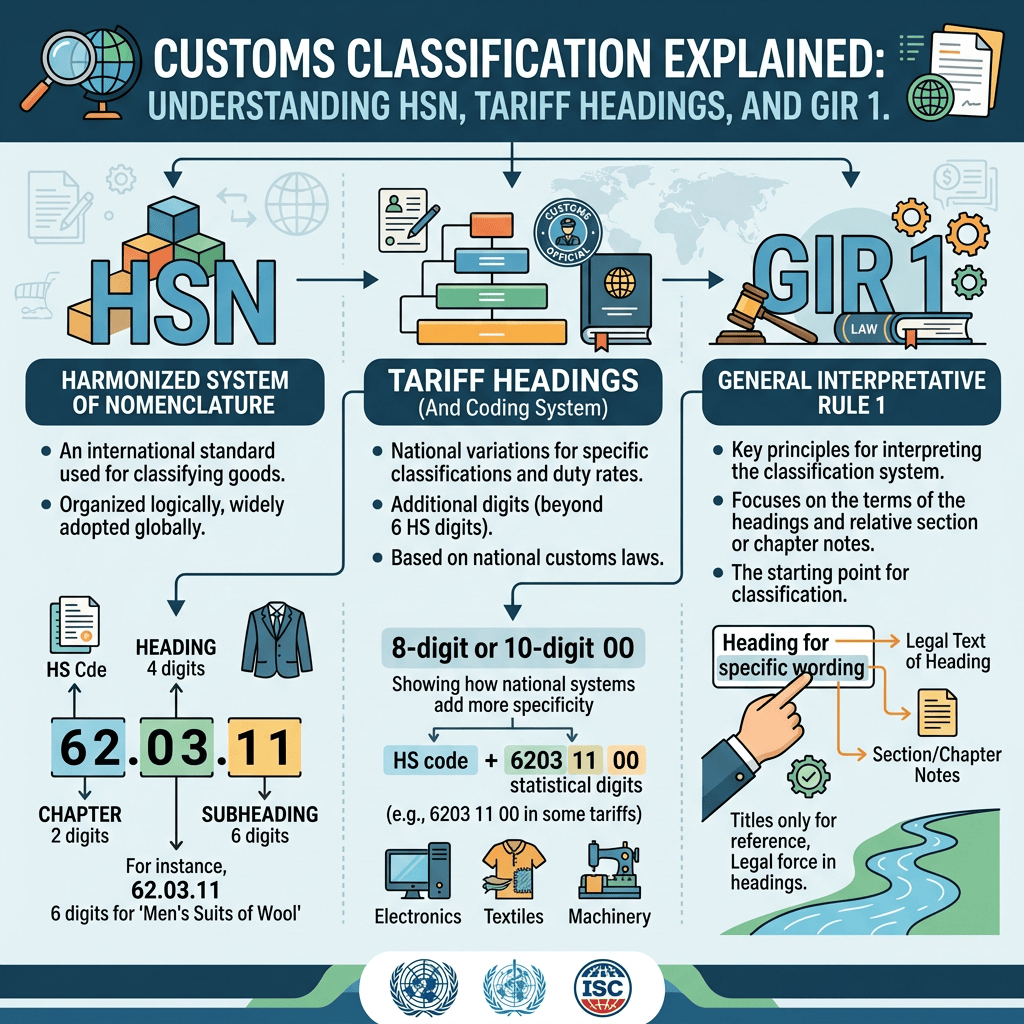
Why the product name alone is not enough to determine its Customs classification.
Determining the correct classification of imported goods is one of the most fundamental aspects of Customs law.
The classification of goods determines the applicable Customs Tariff heading and can consequently affect the rate of duty, availability of exemptions, import policy conditions and other regulatory requirements.
A common mistake is to identify a product by its commercial description and immediately search for a matching tariff entry.
That is not how Customs classification works.
The classification of goods has to be determined by reading the relevant tariff headings together with the applicable Section and Chapter Notes and applying the General Rules for the Interpretation of the Import Tariff, commonly referred to as the GIR.
This article explains the basic structure of the Indian Customs Tariff, the starting point under GIR 1, and how these principles were applied by the CESTAT in Principal Commissioner of Customs (Import) v. M/s Bans International.
1. Understanding the Structure of the Customs Tariff
The Indian Customs Tariff is based on the internationally recognised Harmonized System of classification.
The tariff broadly follows the following hierarchy:
Section
↓
Chapter
↓
Heading
↓
Sub-heading
↓
Tariff Item
- Section – Broad grouping of goods
- Chapter – Two-digit level
- Heading – Four-digit level
- Sub-heading – Six-digit level
- Tariff Item – Eight-digit Indian classification
Therefore, an eight-digit tariff item should not be viewed in isolation. It forms part of a larger classification structure.
Important: The hierarchy of the tariff and the legal method used to classify goods are not exactly the same thing.
This distinction becomes particularly important while applying the General Rules for the Interpretation of the Import Tariff.
2. What is HSN?
The Harmonized System (HS) is an internationally standardised system used for the classification of goods traded across borders.
It organises goods through Sections, Chapters, headings and sub-headings so that internationally traded products can be identified through a common classification framework.
India uses this system as the basis of its Customs Tariff and provides further national-level classification through eight-digit tariff items.
Accordingly, when the expression “HSN code” is commonly used in trade, it is useful to understand whether the reference is being made to a heading, sub-heading or the complete eight-digit Indian tariff item.
3. GIR 1: The Starting Point of Classification
The first and most fundamental rule of tariff classification is General Interpretative Rule 1.
Under GIR 1, classification is determined according to:
- the terms of the relevant headings; and
- the applicable Section Notes and Chapter Notes.
The titles of Sections and Chapters are provided for ease of reference. They are not, by themselves, the legal basis for determining classification.
The title helps us navigate the tariff. The heading and the relevant legal Notes help us determine the classification.
This principle was expressly explained by the CESTAT in Principal Commissioner of Customs (Import) v. M/s Bans International. The Tribunal observed that the Customs Tariff is based on the Harmonised System of Nomenclature and that classification is to be determined according to the tariff headings read with the relevant Section and Chapter Notes. [1]
Therefore, merely because a product appears to fit within the title of a particular Chapter does not automatically mean that it must be classified in that Chapter.
4. Why the Complete Heading Must Be Read
A tariff entry should not be read merely by looking for a keyword which resembles the commercial description of the imported goods.
Consider, for example, a safety seat belt designed exclusively for use in an aircraft.
A person searching the tariff may come across a tariff entry containing the description “Safety seat belts”. However, the description cannot be read in isolation from the heading under which it appears.
This illustrates an important classification principle:
A tariff description should always be read in the context of the heading and the relevant legal Notes.
The same principle becomes clearer when examining an actual classification dispute decided by the CESTAT.
5. Case Study: Principal Commissioner of Customs (Import) v. M/s Bans International
Forum: Customs, Excise & Service Tax Appellate Tribunal (CESTAT), New Delhi
Final Order Nos.: 50420-50422/2023
Customs Appeal Nos.: 51682/2021, 51685/2021 and 51794/2022
Date of Decision: 03 April 2023
Coram: Shri P.V. Subba Rao, Member (Technical) and Ms. Binu Tamta, Member (Judicial)
5.1 What were the imported goods?
M/s Bans International imported various plastic mechanisms used with bottles, including:
- Trigger sprayers for plastic bottles;
- Lotion pump parts for plastic bottles; and
- Fine mist sprayers for plastic bottles.
The importer explained that only the heads or mounts were being imported and that they could be fitted on bottles of the appropriate size to dispense liquids or gels. The goods were used for various purposes, including sanitizers and other products. [2]
5.2 What was the classification dispute?
The importer classified the goods under headings falling within Chapter 84, including heading 8424, relating to mechanical appliances for projecting, dispersing or spraying liquids or powders.
The Department, however, sought classification under CTH 9616, covering scent sprays and similar toilet sprays and mounts and heads therefor.
The original authority had classified the goods differently, but that classification was not supported by either side in the appeal. The dispute before the Tribunal therefore centred principally on whether the goods were classifiable under heading 8424 or heading 9616. [3]
5.3 How did the Tribunal approach the classification?
This is the most useful part of the judgment for understanding GIR 1.
Before examining the competing tariff entries, the Tribunal explained the general scheme of the Customs Tariff and the General Rules of Interpretation.
The Tribunal stated that the titles of Sections and Chapters are provided for ease of reference and that classification is to be determined according to the Customs Tariff headings read with the relevant Section and Chapter Notes. [4]
The Tribunal then examined the competing headings rather than deciding the matter merely by looking at the commercial description of the goods.
5.4 The competing headings
The importer relied upon Heading 8424, which covers:
Mechanical appliances (whether or not hand operated) for projecting, dispersing or spraying liquids or powders…
Within this heading, sub-heading 8424 20 00 covers spray guns and similar appliances, while heading 8424 also contains a provision for parts. [5]
The Revenue relied upon Heading 9616, which covers:
Scent sprays and similar toilet sprays, and mounts and heads therefor…
Heading 9616 10 specifically covers scent sprays and similar toilet sprays and their mounts and heads. [6]
5.5 Why did the Tribunal reject Heading 8424?
The Tribunal examined the nature and functioning of the imported goods.
After examining the samples, the Tribunal found that the imported items were mounts which could be screwed onto bottles and used to dispense the contents either as a spray or as a gel.
The Tribunal held that these were not mechanical appliances for spraying covered under Chapter 84.
The Tribunal also considered the distinction between the type of machinery contemplated by heading 8424 and the mounts and heads covered by heading 9616.
The Tribunal referred to its earlier decision in Commissioner of Customs, Mumbai v. Reckitt & Coleman of India Ltd., where the classification of mounts and heads used to spray or dispense liquid soap had also been considered.
5.6 Did the use of the goods for sanitizers change the classification?
This is one of the most useful observations in the judgment.
The importer argued that the goods were not for scents or toilet sprays and were instead used for sanitizers.
The Tribunal did not accept this argument.
It held that the fact that the mounts were mainly used for sanitizers did not change the classification when the goods were otherwise clearly covered by the relevant tariff heading. [7]
The Tribunal observed that the heading specifically covered the mounts and heads for the relevant sprays.
The end use or the product put into the bottle cannot, by itself, override the tariff description applicable to the imported article.
5.7 Final decision
The Tribunal held that the imported goods were classifiable under CTH 9616 10 10.
Revenue’s appeals in Customs Appeal Nos. 51682/2021 and 51685/2021 were allowed and the matters were remanded to the original authority for determining the duty in accordance with the classification decided by the Tribunal.
Customs Appeal No. 51794/2022 was dismissed as infructuous because it challenged the same impugned order as another appeal. [8]
6. What Does the Bans International Case Teach Us?
The case provides several practical lessons for Customs classification.
Lesson 1: Do not classify goods by keyword
The mere fact that an article can spray or dispense a liquid does not automatically make it a mechanical spraying appliance under heading 8424.
The actual nature and characteristics of the imported goods have to be examined against the tariff heading.
Lesson 2: Read the complete heading
A heading and its sub-headings must be understood within the structure of the tariff.
A particular word in a sub-heading should not be detached from the heading and used as the sole basis for classification.
Lesson 3: Section and Chapter titles are not the classification rule
The Tribunal expressly stated that Section and Chapter titles are provided for ease of reference.
The classification exercise has to be based on the terms of the headings read with the relevant legal Notes.
Lesson 4: End use is not automatically decisive
The Bans International case is particularly useful in demonstrating that the manner in which the goods are ultimately used does not necessarily determine their tariff classification.
In this case, the fact that the imported mounts and heads were used extensively for sanitizers did not take them outside heading 9616 when the Tribunal found that the tariff heading covered the imported articles.
Lesson 5: Examine the goods themselves
The Tribunal considered the physical samples of the imported goods before reaching its conclusion.
This highlights an important practical aspect of classification disputes: technical characteristics, construction, function and the actual nature of the imported article can be critical.
7. A Practical Approach to Customs Classification
The principles discussed above can be converted into a practical classification workflow:
Step 1: Identify the goods
Understand exactly what the product is, including its composition, characteristics, construction, function and intended use wherever relevant.
Step 2: Identify potentially relevant headings
Do not stop at the first tariff description that appears to match the product. Identify all potentially relevant headings.
Step 3: Read the complete heading
Read the complete heading before examining the lower-level tariff entries.
Step 4: Check the relevant Section and Chapter Notes
Determine whether any Note includes, excludes, limits or otherwise affects the proposed classification.
Step 5: Apply GIR 1
Examine the terms of the relevant heading together with the applicable Section and Chapter Notes.
Step 6: Proceed to subsequent GIRs where required
If classification cannot be resolved under GIR 1, the subsequent interpretative rules may need to be examined in their proper sequence.
Step 7: Determine the applicable sub-heading and tariff item
Once the appropriate heading has been established, classification can be taken further to the relevant sub-heading and ultimately to the applicable eight-digit tariff item.
8. The Classification Flow in Simple Terms
Identify the product
↓
Identify potentially relevant headings
↓
Read the complete heading
↓
Check Section and Chapter Notes
↓
Apply GIR 1
↓
Apply subsequent GIRs if required
↓
Determine the sub-heading
↓
Determine the eight-digit tariff item
9. Key Takeaway
Customs classification is not merely the process of finding a tariff description that sounds similar to the commercial name of a product.
A proper classification analysis requires answering several questions:
- What exactly is the product?
- Which tariff headings may potentially cover it?
- What does the complete heading say?
- What do the relevant Section and Chapter Notes provide?
- Can the classification be determined under GIR 1?
- If not, which subsequent GIR becomes relevant?
The Bans International decision demonstrates why this structured approach matters. The Tribunal did not decide the classification merely by looking at the fact that the imported goods were capable of spraying or dispensing liquids. It examined the nature of the goods, the competing tariff headings, the relevant HSN material and the applicable interpretative principles before arriving at the classification.
Do not classify goods by keyword. Read the heading, read the Notes, understand the goods, and then apply the GIR.
Official References
- Customs Tariff Act, 1975 – India Code
- Customs, Excise & Service Tax Appellate Tribunal (CESTAT)
- CBIC Tax Information Portal
Case Reference
Principal Commissioner of Customs (Import), ICD Tughlakabad, New Delhi v. M/s Bans International
Customs Appeal Nos. 51682 of 2021, 51685 of 2021 and 51794 of 2022
Final Order Nos. 50420-50422/2023
CESTAT, New Delhi
Date of Decision: 03 April 2023
Disclaimer: This article is intended solely for educational and informational purposes. Customs classification may depend on the specific nature, composition, technical specifications and use of the goods, as well as the applicable tariff provisions, Section Notes, Chapter Notes, notifications and judicial decisions. This article should not be treated as legal or professional advice.



Leave a Reply