
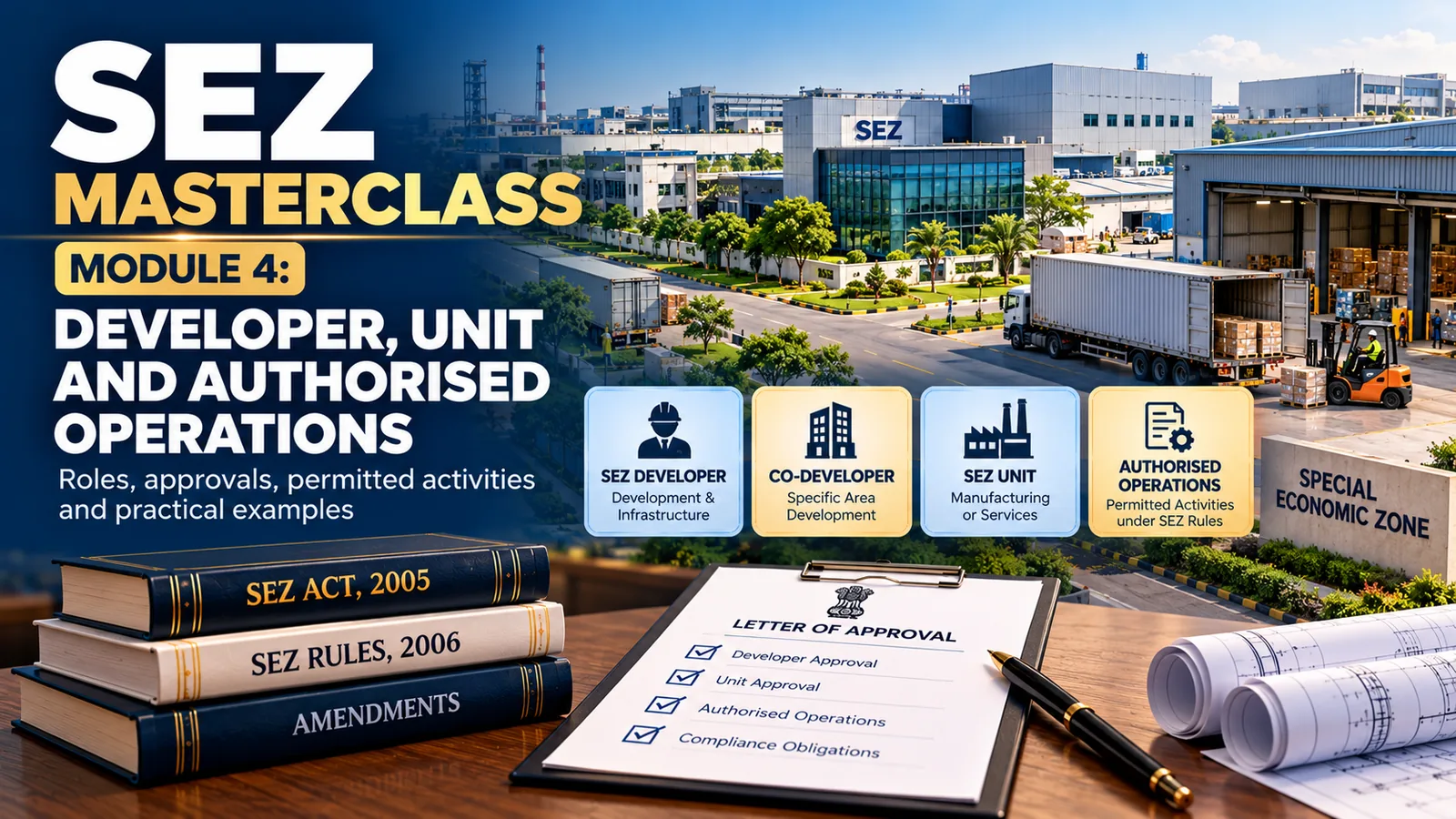
SEZ Developer, Unit & Authorised Operations
A classroom-style guide to who builds and operates an SEZ, who receives approval to run a unit, and how to test whether a proposed activity or procurement is actually covered by the SEZ framework.
What you should be able to do after this lesson
Identify the right actor
Distinguish a developer, co-developer and entrepreneur/unit without mixing up their approvals.
Read the approval
Know why the Letter of Approval (LoA), approved activities and applicable conditions matter.
Test the proposed activity
Use a repeatable method before treating goods, services or works as connected with authorised operations.
Build an audit trail
Know which records to collect and which legal questions to escalate before a procurement or clearance.
1. The three roles: developer, co-developer and unit
Imagine an SEZ as a carefully planned campus. One approved party develops the campus and its infrastructure; a co-developer may undertake specified development responsibilities; separate approved entrepreneurs operate units within the processing area.
| Role | Core idea | Approval lens | Common confusion |
|---|---|---|---|
| Developer | The person or State Government granted the relevant Central Government approval to develop the SEZ under the Act. | SEZ-level approval and the development/operations authorised for that developer, subject to the Act, Rules and conditions. | Assuming the developer’s approval automatically authorises every tenant’s business activity. |
| Co-developer | A party granted the relevant approval to carry out specified development responsibilities in the SEZ. | Scope of the co-developer’s approval and the facilities/activities it covers. | Assuming a commercial contract alone makes a contractor a statutory co-developer. |
| Entrepreneur / Unit | The entrepreneur receives a Letter of Approval to establish and operate a unit for approved activities. | Unit-specific LoA, approved activity, conditions, location and applicable procedural requirements. | Assuming a unit can freely add any business line or use any procurement because it is inside the SEZ. |
Reveal the classroom answer
No. A lease establishes a property/contractual relationship. It does not replace the statutory unit approval process. Verify the company’s own LoA and approved activities, as well as the premises and other applicable requirements.
2. SEZ-level approval vs unit-level approval
Can this zone and its development be established?
Focus on the Central Government’s relevant approval/notification framework, developer and co-developer status, demarcation and approved development responsibilities.
Can this entrepreneur operate this unit?
Focus on the unit’s LoA, approved activity, validity/commencement requirements, conditions and applicable monitoring or amendment procedure.
These layers interact, but they are not interchangeable. The developer’s infrastructure approvals do not automatically become the unit’s authorisation to manufacture, trade, provide services or claim a particular tax/customs treatment.
3. What does “authorised operations” mean in practice?
The SEZ Act defines “authorised operations” by reference to the operations that may be authorised under the specified provisions of the Act. In practice, the phrase is a legal gateway, not a universal label that automatically covers every expense incurred by a developer or unit.
Use the five-question test
Developer, co-developer, unit, contractor or supplier?
Check the LoA, approved operations and conditions.
Link the goods/services to the specific operation, not just the address.
Check the relevant SEZ Rules, forms, authorisation and Customs process.
Keep approvals, contracts, technical notes, invoices and receipt/use records.
4. Goods, services and works: examples from the field
These examples are issue-spotting exercises, not automatic rulings. The answer can change with the actor, approval, purpose, applicable notification/rule and documents.
| Proposed spend / activity | What to examine | Do not assume |
|---|---|---|
| Steel, cement or electrical systems for SEZ infrastructure | Who is procuring; developer/co-developer approval; whether the work is within the relevant authorised development operations; prescribed documentation and procedure. | Every construction input is automatically eligible merely because it is delivered inside the boundary. |
| Production machinery for an approved manufacturing unit | Unit LoA and approved activity; use in the unit; applicable procurement/import procedure; inventory and use records. | Every machine or item of equipment is covered irrespective of actual use or approval conditions. |
| Laptops, furniture or office fit-out | Whether the item supports an approved operation, the relevant legal treatment, applicable restrictions and evidence of use. | “Office use” automatically means authorised or exempt. |
| Consultancy, software or maintenance service | Service recipient, contract scope, link to approved operations, invoicing/tax rules and evidence that the service was received. | All services billed to an SEZ entity receive identical treatment. |
| Repair, job work or temporary removal of goods | Applicable permission/procedure, identification of goods, movement records, time limits and return/reconciliation requirements. | Goods can leave and return without controls because the original procurement was approved. |
| Contractor or subcontractor works | Contract chain, actual recipient, scope of approval, access/movement controls and which party is responsible for records and compliance. | A contractor inherits the unit’s or developer’s approval simply by working on site. |
5. Interactive classroom: would you approve the file?
Scenario A: An approved manufacturing unit wants to procure a specialised testing machine. The sales team says, “We are in an SEZ, so no need to check anything else.” What is the best first response?
Scenario B: A developer’s contractor wants to import equipment for a project. The purchase order mentions the SEZ, but the project scope and approval documents are unclear. What should the customs broker do?
Scenario C: A unit adds a new line of business that does not clearly match the activities stated in its existing LoA. What is the safest approach?
6. A practical file-review workflow
Current LoA, amendments, approval letters, contracts, invoices and technical description.
Match legal names, GSTIN/PAN where relevant, role, premises and actual recipient.
Write one sentence explaining the operational need and connect it to the approved activity.
Review the Act, current Rules, applicable notification/instruction and procedure.
Document the basis, missing evidence, approval reference and any conditions/next steps.
7. Documents and evidence checklist
Use this as a working checklist. Not every item will be necessary in every case; the required set depends on the transaction and current procedure.
8. Common mistakes that create avoidable risk
Mistake 1: Treating the SEZ address as the legal test
Mistake 2: Confusing developer approval with unit approval
Mistake 3: Treating every expense as an authorised operation
Mistake 4: Relying on an old consolidated copy of the Rules
Mistake 5: Ignoring separate statutory requirements
9. Frequently asked questions
Does every unit in an SEZ need its own Letter of Approval?
Does the developer’s LoA automatically cover all tenants?
Can a unit freely change its approved activity?
Are all goods used in an SEZ automatically duty-free?
Is an authorised operation the same thing as a tax exemption?
What if the approval wording is broad or unclear?
10. Quick revision quiz
Official sources and further reading
Use the primary law and current official material for live decisions. The Customs Law Manual, 2025–26 uploaded for this project is a useful secondary reference, but it should not replace checking the latest notifications, amendments and instructions.
Current-law check: The official SEZ portal lists the Special Economic Zones (Third Amendment) Rules, 2026 and (Fourth Amendment) Rules, 2026 dated 15 October 2026; a second amendment dated 9 July 2026; and Instruction No. 123 dated 23 February 2026 concerning execution of the Bound-cum-Legal Undertaking by SEZ developers/units. Review the actual documents for their scope and effective dates before relying on a specific proposition.
Continue the SEZ Masterclass
Understanding SEZs from Zero
Start with the concept, purpose and core vocabulary.
Read Module 1 →SEZ Authorities and Approvals
Understand who does what in the approval structure.
Read Module 3 →Importing Goods into an SEZ
Next, follow goods from planning and documentation through entry, receipt and records.
Coming nextLearning path: 4 of 12 modules planned.


Leave a Reply