
CustomsDesk · Live Updates
Daily Customs & DGFT Update
Customs notifications, trade remedies, export policy and international trade developments.
01 | Executive Summary
| Development | Key Point | Who Should Review It? |
|---|---|---|
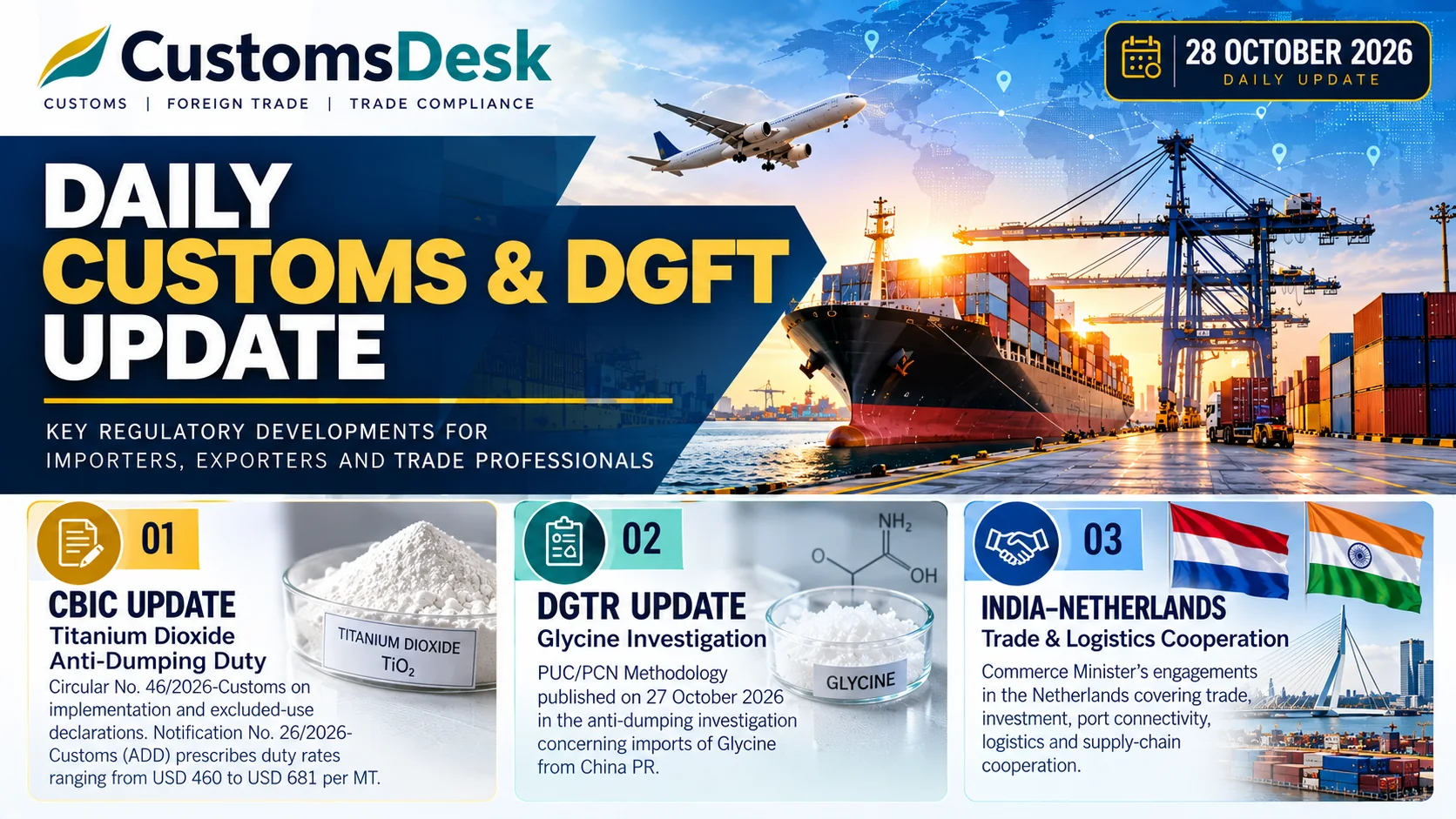
| CBIC Circular No. 46/2026-Customs | Operational guidance concerning anti-dumping duty on specified Titanium Dioxide imports and excluded-use declarations. | Importers, customs brokers and end-use compliance teams. |
| DGTR: Glycine investigation | PUC/PCN Methodology published on 27 October 2026 in the anti-dumping investigation concerning Glycine from China PR. | Importers, producers, exporters and interested parties. |
| India–Netherlands cooperation | Official engagements focused on trade, investment, port connectivity, logistics and supply-chain cooperation. | Exporters, logistics operators and businesses exploring India–Europe trade. |
This digest summarises selected trade and regulatory developments associated with 27 October 2026. Consult the underlying official documents for the full legal scope, conditions and procedural requirements.
02 | CBIC: Titanium Dioxide Anti-Dumping Duty
Circular No. 46/2026-Customs dated 27 October 2026
CBIC issued Circular No. 46/2026-Customs concerning the implementation of anti-dumping duty on Titanium Dioxide originating in or exported from China PR. The circular addresses the declaration procedure for goods claimed to qualify for specified excluded-use treatment under the applicable anti-dumping duty framework.
Product scope and excluded-use declarations
The related Notification No. 26/2026-Customs (ADD), dated 24 October 2026, specifies the applicable product scope, duty rates and conditions. The relevant tariff items include 2823 00 10, 3206 11 10 and 3206 11 90, subject to the exact product description and the terms of the notification.
The framework also contains conditions for specified end uses and certain nano or ultrafine Titanium Dioxide products. Importers must examine the precise exclusions and declaration procedure rather than relying on tariff classification alone.
Importers should verify the product description, manufacturer, country-of-origin and country-of-export conditions, applicable duty rate and any claimed exclusion before filing the Bill of Entry. Customs brokers should ensure that the supporting documents and end-use declarations correspond to the applicable notification and circular.
The applicable notification provides different anti-dumping duty rates for specified producers and other categories of imports, ranging from USD 460 to USD 681 per metric tonne.
Access to a producer-specific rate is conditional upon compliance with the notification’s requirements, including the prescribed dated and signed declaration on the commercial invoice identifying the manufacturer and confirming the accuracy of the relevant information.
Before claiming an individual producer’s rate, importers should verify the producer’s identity, the required invoice declaration and all other conditions in the notification. If the requirements for a producer-specific rate are not met, the applicable residual rate may apply.
Excluded-use treatment is conditional. Importers should retain evidence supporting the declared end use and ensure that the goods are used in accordance with the applicable requirements. Diversion from an eligible use may result in consequences under the governing legal instruments, including duty liability where applicable.
Official source: Central Board of Indirect Taxes and Customs (CBIC)
Notification reference: e-Gazette of India. Locate Notification No. 26/2026-Customs (ADD), dated 24 October 2026.
Additional reading: Summary of the Titanium Dioxide ADD declaration procedure. Verify the operative requirements against the official notification and circular.
03 | DGTR: Glycine from China PR
PUC/PCN Methodology published on 27 October 2026
The Directorate General of Trade Remedies (DGTR) published the PUC/PCN Methodology in the anti-dumping investigation concerning imports of Glycine originating in or exported from China PR.
The investigation record identifies File No. 6/41/2026-DGTR and SETU Case ID AD/OI/045/2026. The initiation notification is dated 22 September 2026, while the PUC/PCN Methodology is dated 27 October 2026.
Understanding PUC and PCN
- PUC (Product Under Consideration): Defines the product being examined in the investigation.
- PCN (Product Control Number): A methodology for distinguishing relevant product types or characteristics to support appropriate comparisons in the investigation.
- Product characteristics: Specifications, purity, grade and other characteristics may be relevant where recognised by the official methodology.
Relevant tariff items may include 2922 49 10 and 2922 49 90, subject to the precise product description and applicable tariff classification. Tariff headings alone do not determine the complete scope of an anti-dumping investigation.
Importers, exporters and producers dealing in Glycine from China PR should review the methodology, compare it with their product specifications and preserve relevant technical and transaction records. Interested parties should follow the procedural directions and deadlines in the official investigation record.
Stakeholders dealing in different Glycine grades, including USP/IP, food, industrial or feed grades, should check whether the official methodology recognises those distinctions and how the relevant product characteristics should be reported.
Submit comments or proposed product-control codes within the deadline specified by DGTR. Do not assume that every grade automatically constitutes a separate PCN; the proposal should be supported by the methodology and relevant product characteristics.
Publication of the PUC/PCN Methodology is a procedural development in an ongoing investigation. It does not, by itself, mean that anti-dumping duty has been imposed.
Official investigation page: DGTR: Glycine from China PR
DGTR notifications: Official SETU notification portal
04 | India–Netherlands: Trade and Logistics Cooperation
Official engagements reported on 27 October 2026
The Ministry of Commerce and Industry reported on engagements during the Commerce Minister’s Netherlands visit, including discussions on bilateral trade, investment, port connectivity, resilient supply chains and cooperation between Indian and Dutch businesses.
The engagements included a visit to the Port of Rotterdam and discussions concerning logistics, manufacturing, clean energy, technology and wider commercial opportunities. The Netherlands’ role as a gateway to European markets was part of the broader trade and connectivity discussion.
Exporters and logistics businesses may monitor future bilateral initiatives and commercial opportunities arising from India–Netherlands cooperation. This is a trade-development update, not a new customs duty concession, import exemption or amendment to the Foreign Trade Policy.
Official source: Press Information Bureau: India–Netherlands trade and investment engagement
05 | Key Takeaways for Importers and Exporters
- Titanium Dioxide importers: Review Circular No. 46/2026-Customs with Notification No. 26/2026-Customs (ADD), including the product scope, applicable duty rate and excluded-use conditions.
- Producer-specific ADD claims: Verify the manufacturer, prescribed commercial-invoice declaration and other conditions before claiming an individual rate.
- Customs brokers: Check end-use declarations and supporting records before filing the Bill of Entry for goods claimed to qualify for an exclusion.
- Glycine stakeholders: Review the DGTR PUC/PCN Methodology and submit relevant comments or proposals within the deadline stated in the official record.
- Exporters and logistics businesses: Monitor India–Netherlands cooperation for future commercial opportunities, while distinguishing policy dialogue from an operative customs benefit.
- Compliance teams: Retain official documents and check for subsequent amendments or implementation instructions before taking action.
06 | Official Source Directory
- CBIC: Official website for customs circulars, notifications and instructions.
- e-Gazette: Official Gazette of India for published statutory notifications.
- DGTR: Official website for anti-dumping and other trade-remedy investigations.
- DGTR SETU: Investigation notifications and records.
- DGFT: Official website for Foreign Trade Policy, notifications and trade notices.
- ICEGATE: Official customs e-filing portal.
- Press Information Bureau: Official government press releases.
07 | Verification Note and Disclaimer
This digest is prepared for informational and educational purposes. It is not a substitute for the full text of a notification, circular, trade notice, investigation document or other applicable legal instrument.
Readers should verify the current official document, effective date, product scope, tariff classification, duty rate, end-use conditions, procedural deadlines and subsequent amendments before acting. Where a secondary source is provided for convenience, the official government publication should be treated as authoritative.
In trade-remedy matters, initiation, procedural methodology, preliminary findings, final findings and imposition of duty are distinct stages. The applicable legal position must be determined from the relevant official records.
Judicial decisions of the Supreme Court, High Courts and CESTAT are not covered in this Daily Digest. They are reserved for separate CustomsDesk case-analysis articles.


Leave a Reply