
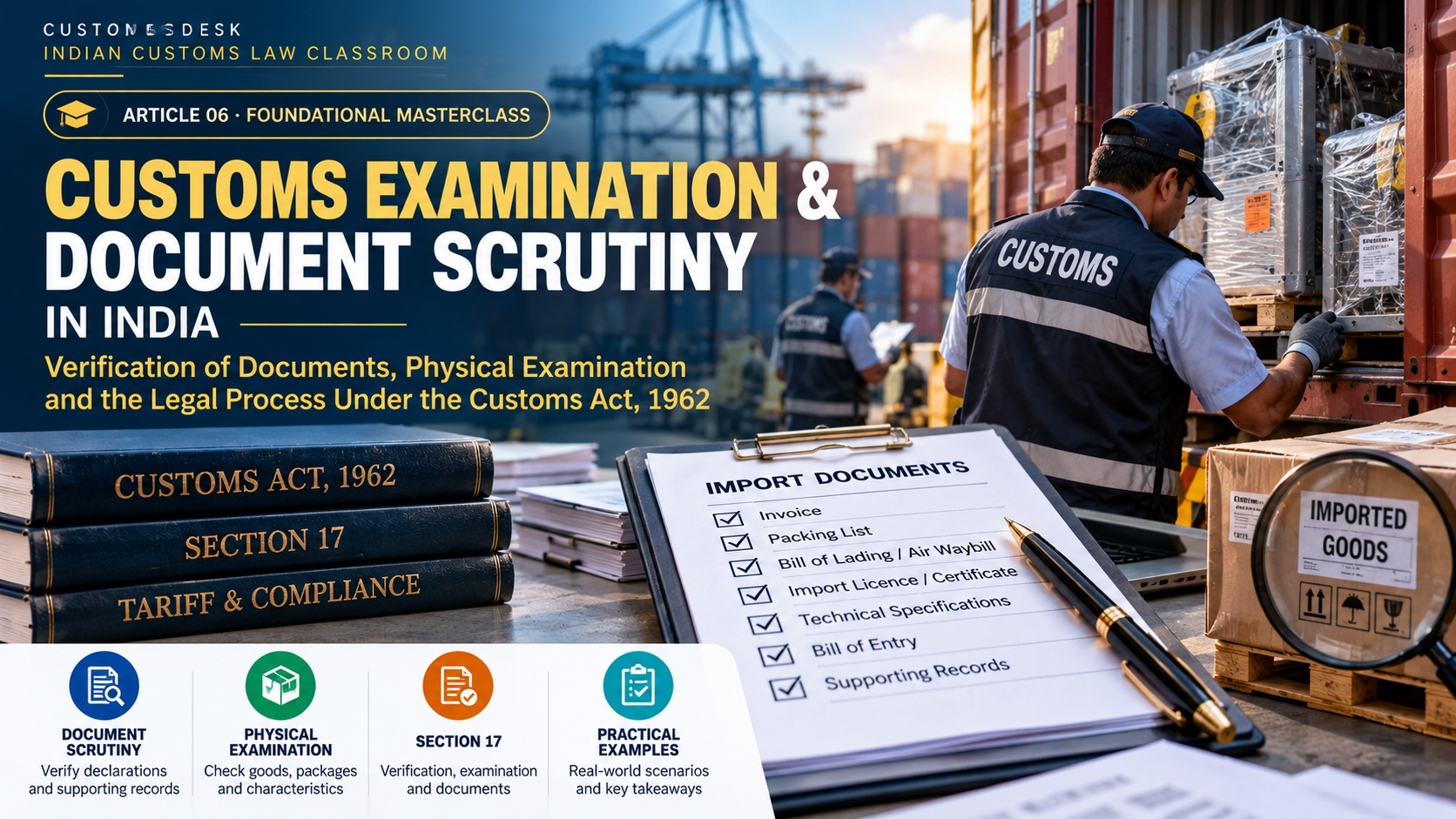
Customs Examination & Document Scrutiny
From the Bill of Entry to the Physical Examination of Goods
What happens when Customs wants to verify the documents, description, quantity or characteristics of imported goods?
This lesson is also available as a video below. Prefer reading? Continue with the article underneath.
Customs Examination & Document Scrutiny
Prefer to watch on YouTube? Open the video on YouTube ↗
From Classification to Examination
We will study the legal framework for clearance under Section 47 and how it fits into the complete import process.
Quick Recap: What Have We Learnt?
- Article 01: Customs Classification Explained
- Article 02: Customs Valuation in India
- Article 03: Customs Duty Calculation
- Article 04: Bill of Entry Under the Customs Act, 1962
- Article 05: Customs Assessment Under Section 17
1. A Shipment Arrives. Customs Has Questions.
Imagine that ABC India Pvt. Ltd. imports an industrial machine from Germany. The Bill of Entry describes the goods as an industrial processing machine. The importer has submitted an invoice, packing list, transport document and technical catalogue.
During Customs processing, an officer notices that the description on the invoice is brief, while the technical catalogue identifies several functions and components. The officer wants to understand exactly what has been imported.
Three questions guide today’s lesson
2. Document Scrutiny vs Physical Examination
These terms are related, but they do not mean the same thing.
| Aspect | Document scrutiny | Physical examination |
|---|---|---|
| What is reviewed? | Declarations, invoices, packing lists, licences, certificates and other relevant records. | The goods, packages, markings, quantity or selected characteristics, as specified by the examination process. |
| Primary purpose | Check consistency, completeness and the legal relevance of the information declared. | Verify relevant physical facts about the goods. |
| Example | Comparing the invoice description with a technical catalogue. | Checking whether the selected goods or packages correspond to the declared description. |
| Possible result | Documents may be accepted, or clarification and further records may be requested. | The findings may support the declaration or indicate that further inquiry is needed. |
3. The Legal Basis for Customs Verification
Section 17(2) of the Customs Act, 1962 empowers the proper officer to verify the entries made under Section 46 or Section 50 and the related self-assessment. For this purpose, the officer may examine or test imported or export goods, or the necessary part of them.
The subsection also provides that the selection of cases for verification shall primarily be based on risk evaluation through appropriate selection criteria.
What does this mean in practice?
- There is a declaration.The importer or exporter has submitted the relevant entry and self-assessment.
- Verification is undertaken.The proper officer may verify the relevant entries and self-assessment under the statutory framework.
- Examination or testing may be used.Where necessary, the goods or selected parts may be examined or tested.
- The result is evaluated.The findings are considered with the declaration, documents and applicable law.
4. Documents and Information: What May Customs Ask For?
Section 17(3) permits the proper officer, for the purposes of verification under Section 17(2), to require the importer, exporter or another person to produce documents or information through which the duty leviable can be ascertained.
The relevant documents depend on the goods, the declaration and the issue being verified. The following list is illustrative, not a mandatory checklist for every shipment.
How should an importer respond to a query?
- Identify the exact question or discrepancy raised.
- Locate the relevant supporting document or technical evidence.
- Explain how the evidence relates to the declaration and applicable legal provision.
- Submit the response through the prescribed process and retain a copy of the records.
5. How Does an Examination Fit into the Import Process?
The exact sequence depends on the applicable procedure, the goods, the Customs station and the instructions generated for the consignment. The following is a simplified learning model, not a promise that every Bill of Entry follows identical steps.
- Bill of Entry and declaration.The importer files the relevant entry and supplies the prescribed information.
- Assessment and verification.The declaration and self-assessment are processed under the applicable framework.
- Examination instruction, where applicable.The relevant order or instruction identifies the examination required under the procedure in force.
- Examination and reporting.The designated personnel examine the goods or selected parts and record the findings through the applicable system.
- Findings are considered.The findings may support the declaration or lead to a request for clarification, further verification or reassessment where legally justified.
CBIC has issued operational instructions concerning risk-based examination orders and recording examination findings. Such instructions must be read in their own scope and alongside any later instructions applicable to the relevant Customs station or category of goods.
Consult the CBIC Tax Information Portal for official Acts, rules, circulars and instructions ↗
6. The Industrial Machine: Declaration vs Actual Goods
Let us return to ABC India Pvt. Ltd. The importer has declared an industrial machine and selected a tariff heading. During verification, Customs asks for technical specifications because the commercial invoice does not fully explain the machine’s function.
Scenario A: Documents support the declaration
The technical catalogue and other records explain the machine’s function and components. The evidence is consistent with the declared description.
Scenario B: A material difference is identified
The examination report records a characteristic or component that appears inconsistent with the declaration. Customs seeks clarification and considers the supporting evidence.
Scenario C: The discrepancy may affect classification or duty
If the evidence establishes that the self-assessment was incorrect, Section 17(4) may become relevant. The proper officer must apply the statutory framework and any procedural safeguards that apply to the decision.
7. Examination Findings and Reassessment
Examination and reassessment are related, but they are distinct steps. Examination may produce evidence relevant to the correctness of a declaration. Reassessment under Section 17(4) concerns the duty where the self-assessment is found incorrect, subject to the statutory conditions.
| Finding | Possible next step |
|---|---|
| The goods and declaration appear consistent. | The findings may support the declared particulars, subject to the remaining legal requirements. |
| A document is unclear or missing. | Further information or documents may be requested under the applicable process. |
| A material characteristic differs from the declaration. | The difference may require explanation, further verification or consideration under the relevant legal provisions. |
| Self-assessment is found incorrect. | Section 17(4) may apply. Where Section 17(5) applies, its speaking-order requirement and written-acceptance exception must be considered. |
8. Six Mistakes Importers and Beginners Should Avoid
Correction: Section 17(2) provides a verification framework with risk-based selection. Do not assume that every consignment receives the same examination.
Correction: Identify whether the matter is a request for information, a verification step, a reassessment or another formal action.
Correction: Classification depends on the applicable tariff wording, relevant Notes and the goods’ actual characteristics.
Correction: Respond to the specific issue with relevant, consistent evidence.
Correction: Legal consequences depend on the applicable provision, its ingredients and the evidence.
Correction: Examination is one part of the process. The legal requirements for clearance must separately be satisfied.
9. Document and Examination Readiness Checklist
Before responding to a Customs query or preparing for a possible examination, review these points as relevant to the transaction.
- Does the Bill of Entry describe the goods accurately?
- Do the invoice, packing list and transport documents tell a consistent story?
- Are technical specifications available to explain the goods’ functions and characteristics?
- Is the declared classification supported by the goods and applicable tariff rules?
- Is the valuation supported by the transaction documents and applicable valuation rules?
- Have relevant licences, certificates, permits and exemption conditions been checked?
- Has the exact examination instruction or Customs query been identified?
- Are responses and supporting records being retained?
- If findings appear inconsistent with the declaration, has the relevant legal provision and appropriate next step been considered?
10. Classroom Quiz
Try answering each question before revealing the answer.
Q1. Which provision allows verification of entries and self-assessment?
Answer: Section 17(2) of the Customs Act, 1962.
Q2. Which provision allows Customs to request relevant documents or information for verification?
Answer: Section 17(3).
Q3. Is physical examination mandatory for every consignment?
Answer: No. Section 17(2) provides a verification framework and states that selection for verification shall primarily be based on risk evaluation through appropriate selection criteria.
Q4. What is the difference between document scrutiny and physical examination?
Answer: Document scrutiny examines the declaration and supporting records. Physical examination checks the goods or selected parts of them, as required by the applicable procedure.
Q5. Does a discrepancy automatically prove fraud?
Answer: No. The facts, explanation, evidence and legal ingredients of any proposed action must be examined.
Q6. If examination findings suggest self-assessment was incorrect, which provision may become relevant?
Answer: Section 17(4), subject to the statutory conditions. The applicability of Section 17(5) must also be considered where reassessment differs from self-assessment.
Q7. Does completing examination itself mean goods have been cleared for home consumption?
Answer: No. Examination and clearance are distinct steps. The legal framework for clearance will be studied in Article 07.
11. Official Sources and Further Reading
- CBIC Tax Information Portal: Section 17, Assessment of Duty ↗
- CBIC Tax Information Portal: Section 46, Entry of Goods on Importation ↗
- CBIC: Customs control and clearance procedures overview ↗
- ICEGATE: Indian Customs EDI System ↗
- ICEGATE Compliance Information Portal: Commodity-wise import and export procedures ↗
Editorial note: Operational procedures and risk-based examination instructions may change. Before relying on a specific examination requirement, percentage, system workflow or timeline, verify the latest official circular, instruction, regulation and its applicability to the relevant Customs station and goods.
What Have We Learnt Today?
Customs examination and document scrutiny help verify information relevant to the import declaration and self-assessment. Section 17(2) provides the verification and examination framework, while Section 17(3) allows relevant documents or information to be required for verification.
Examination findings may support the declaration or raise issues requiring clarification, further verification or reassessment under the applicable law. A query is not automatically a final adverse decision, and a discrepancy alone does not establish fraud.
Disclaimer: This article is for general educational and professional awareness only. It is not legal, tax or customs-clearance advice. The applicable law and procedure depend on the facts, goods, relevant date, official instructions and statutory provisions in force.


Leave a Reply