
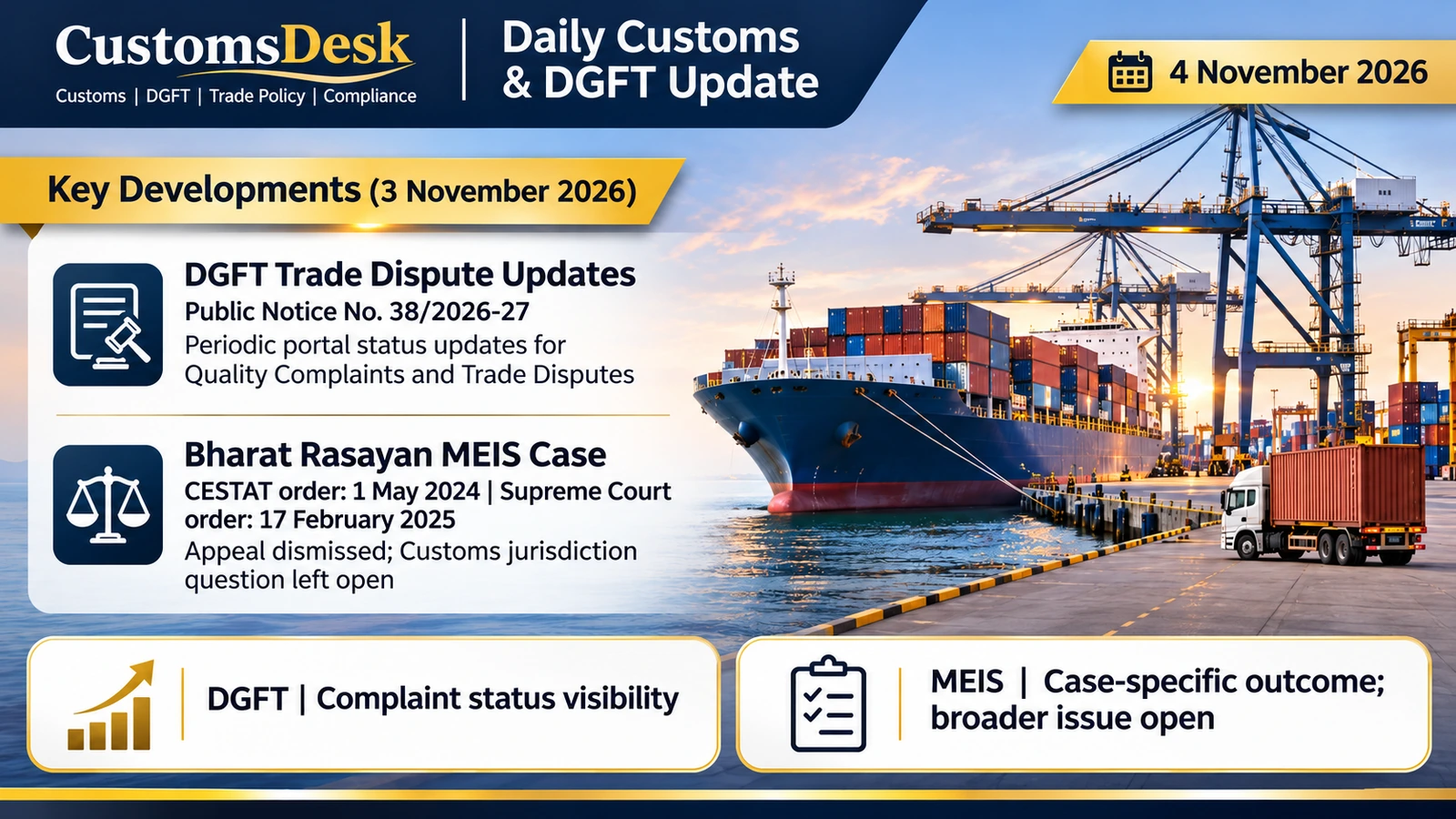
Daily Customs & DGFT Update | 04 November 2026
DGFT introduces online visibility of export trade disputes; Bharat Rasayan MEIS litigation offers an important jurisdictional lesson
Introduction
Today, let us examine an important distinction in foreign trade administration: the difference between registering a complaint and ensuring that the complaint is followed through to its logical conclusion.
The DGFT’s Public Notice No. 38/2026-27, dated 03 November 2026, addresses this very issue by revising the procedure for handling Quality Complaints and Trade Disputes under the Handbook of Procedures, 2023. The amendment introduces a requirement for periodic status updates on the DGFT portal, making the progress of complaints visible to the complainant.
We will also revisit the Bharat Rasayan MEIS dispute, which was reported in legal updates on 03 November 2026. The underlying CESTAT and Supreme Court orders, however, were delivered in 2024 and 2025 respectively. Their relevance lies in the continuing distinction between the functions of Customs authorities and the licensing authority, DGFT.
Let us examine the developments carefully, without confusing a procedural improvement with a guaranteed remedy or a case-specific judicial outcome with a universal rule.
1. Today’s regulatory snapshot
| Authority | Document / Case | Date relevant to this edition | Subject | Nature of development |
|---|---|---|---|---|
| DGFT | Public Notice No. 38/2026-27 | Issued 03 November 2026 | HBP 2023, Paragraph 8.04(iii) | Periodic online status updates for Quality Complaints and Trade Disputes |
| CESTAT Mumbai | Bharat Rasayan Ltd. v. Commissioner of Customs, Nhava Sheva-II | Reported on 03 November 2026; order dated 01 May 2024 | MEIS scrips and Customs jurisdiction | Tribunal set aside the Commissioner’s order in the particular dispute |
| Supreme Court of India | Commissioner of Customs, Nhava Sheva-II v. Bharat Rasayan Ltd. | Reported on 03 November 2026; order dated 17 February 2025 | Revenue’s appeal against the CESTAT decision | Appeal dismissed; general question of Customs’ power and jurisdiction expressly left open |
Date note: The Bharat Rasayan matters are included because they were reported on the coverage date. They are not fresh judgments delivered on 03 November 2026. The underlying dates are stated separately below.
2. DGFT revises the procedure for Quality Complaints and Trade Disputes
2.1 What has been issued?
The Directorate General of Foreign Trade has issued Public Notice No. 38/2026-27 dated 03 November 2026, amending Paragraph 8.04(iii) of the Handbook of Procedures, 2023.
The amendment concerns the handling of Quality Complaints and Trade Disputes involving Indian exporters and overseas parties.
The central idea is straightforward: complaints should not merely be forwarded to the concerned authorities. Their progress should also be periodically updated on the DGFT portal so that the complainant can follow the action being taken.
Verification status in the supplied draft: The draft records this as verified from the original Public Notice PDF supplied for examination. This status has not been independently rechecked during HTML production.
2.2 Understanding the background
International trade disputes do not always arise from customs duty, classification or export policy restrictions.
An exporter may face a complaint from an overseas buyer regarding the quality of goods supplied. Equally, an Indian exporter may have a grievance against a foreign buyer or another overseas commercial party.
Such disputes can affect commercial relationships, payment realisation and the reputation of Indian suppliers.
The Handbook of Procedures provides a framework for handling Quality Complaints and Trade Disputes. Indian Missions Abroad can play an important role in taking up complaints with the authorities concerned in the relevant foreign country.
But there is a practical difficulty: a complainant may submit a complaint and then have limited visibility into what action has actually been taken.
This is the procedural issue addressed by the present amendment.
2.3 What exactly has changed?
Public Notice No. 38/2026-27 substitutes Paragraph 8.04(iii) of the Handbook of Procedures, 2023.
The revised provision deals with the following responsibilities:
- Taking up complaints: Indian Missions Abroad are to take up complaints with the authorities concerned.
- How a complaint reaches the Mission: The complaint may be filed by the applicant or referred by the concerned Foreign Trade Division.
- Periodic status updates: Both the Indian Mission Abroad and the concerned Foreign Trade Division are required to periodically update the action taken and status of each complaint on the DGFT portal.
- Visibility for the complainant: The status updates are to be accessible to the complainant.
The important change is therefore not merely the forwarding of a complaint. It is the requirement to maintain and make available a continuing record of the action taken.
2.4 Let us understand the practical effect
Consider an Indian manufacturer exporting engineering components to a buyer in another country.
After receiving the consignment, the overseas buyer raises a quality complaint. The Indian exporter disputes the allegation and approaches the relevant authorities through the prescribed mechanism.
Under the revised procedure, the Indian Mission Abroad and the concerned DGFT Foreign Trade Division are expected to periodically update the action and status of the complaint on the DGFT portal.
The exporter can then access the available status information instead of remaining entirely dependent on informal follow-ups.
This is a useful improvement in procedural transparency.
However, pay attention to what the amendment does not say. It does not guarantee that the overseas buyer will pay the exporter, that the foreign authority will decide in the exporter’s favour, or that the commercial dispute will be resolved within a fixed period.
2.5 Who is affected?
The amendment is relevant to:
- Indian exporters dealing with overseas quality complaints.
- Exporters involved in international trade disputes.
- DGFT Foreign Trade Divisions handling such complaints.
- Indian Missions Abroad taking up complaints with foreign authorities.
- Businesses seeking visibility into the progress of complaints.
2.6 Practical compliance implications
Exporters should take the following steps:
First, maintain a complete complaint record. Preserve the purchase order, contract, invoice, shipping documents, inspection reports, test certificates, correspondence and evidence supporting the complaint.
Second, submit a properly documented complaint. The factual background, nature of the dispute, amount involved and relief sought should be clearly explained.
Third, monitor the DGFT portal. The revised procedure makes portal-based status visibility an important part of the complaint-handling process.
Fourth, retain follow-up records. If the status is not updated or the information appears incomplete, maintain a record of representations and follow-ups made to the concerned authority.
Fifth, do not treat portal status as a commercial settlement. The status update is a procedural transparency measure. It does not replace contractual remedies, arbitration, litigation or other available legal options.
2.7 Important legal observations
There are some limitations that exporters should understand.
- The provision requires periodic updates, but the text examined does not prescribe a fixed number of days between updates.
- It does not create a guaranteed timeline for resolution.
- It does not provide for automatic compensation or recovery of export proceeds.
- It does not establish a deemed acceptance of the exporter’s complaint.
- It does not introduce a new penalty or appeal mechanism in the text examined.
There is also a publication point worth noting. The Public Notice bears the date 03 November 2026 and states that it is to be published in the Gazette of India Extraordinary, Part I, Section I. The actual Gazette publication date has not been independently established for this draft. No separate commencement date has been identified in the copy examined.
Practical takeaway: Exporters should welcome the improved visibility, but should continue to protect their commercial and legal position independently.
3. Bharat Rasayan MEIS dispute: A useful reminder about the respective roles of Customs and DGFT
3.1 Why are we discussing this matter?
Two related Bharat Rasayan decisions were reported by a legal publisher on 03 November 2026:
- The CESTAT Mumbai decision in Bharat Rasayan Ltd. v. Commissioner of Customs, Nhava Sheva-II, dated 01 May 2024.
- The Supreme Court decision in Commissioner of Customs, Nhava Sheva-II v. Bharat Rasayan Ltd., dated 17 February 2025.
These are not fresh decisions of 03 November 2026. They are included as judicial developments reported on that date and are relevant to the administration of MEIS benefits and the relationship between Customs and DGFT.
3.2 Background of the dispute
The dispute concerned exports of Lambda Cyhalothrin Technical.
The exporter had classified the goods under Customs Tariff Heading CTH 38089199 and claimed benefits under the Merchandise Exports from India Scheme (MEIS).
The Customs Department disputed the classification and contended that the goods should instead fall under CTH 38086900.
The dispute extended beyond one shipping bill and involved earlier exports as well. The Department sought recovery of MEIS benefits exceeding ₹5.86 crore, along with other consequences, including interest, redemption fines and penalties.
The exporter, on the other hand, relied on the fact that DGFT had examined the classification and issued the corresponding MEIS scrips.
3.3 What did CESTAT Mumbai decide?
In its Final Order No. 85446/2024 dated 01 May 2024, CESTAT Mumbai set aside the Commissioner’s order and allowed the exporter’s appeal with consequential relief in accordance with law.
The Tribunal examined the statutory framework governing MEIS and the respective functions of Customs and DGFT.
The central issue was whether Customs could, in the circumstances of the case, effectively withdraw or invalidate MEIS benefits and scrips issued by DGFT without the licensing authority first cancelling the relevant instruments through the prescribed procedure.
The Tribunal’s decision turned on the particular facts and statutory framework before it. It also considered the absence of proceedings by DGFT to cancel the relevant authorisations or scrips.
The Tribunal additionally took note of discrepancies in the Commissioner’s adjudication order, including inconsistencies between amounts expressed in figures and in words. These observations formed part of its criticism of the adjudication.
3.4 What did the Supreme Court decide?
The Revenue challenged the CESTAT decision before the Supreme Court.
In its order dated 17 February 2025, in Commissioner of Customs, Nhava Sheva-II v. Bharat Rasayan Ltd., the Supreme Court dismissed the appeal.
The Court noted that DGFT had earlier examined the classification of Lambda Cyhalothrin Technical under CTH 38089199 and had issued the corresponding MEIS scrips.
However, the most important part of the order is the Court’s express clarification that the issue concerning the power and jurisdiction of the Customs authorities was left open.
This qualification is critical.
The Supreme Court did not use the case to settle the general jurisdictional question for every future dispute involving Customs and DGFT. It dismissed the Revenue’s appeal in the circumstances before it while leaving that broader issue open.
3.5 Let us understand the legal significance
Do not read the outcome as meaning that Customs can never question an exporter’s classification or examine the correctness of an export declaration.
Customs authorities have statutory responsibilities concerning assessment, classification, export clearance and enforcement under the Customs law.
DGFT, on the other hand, administers the Foreign Trade Policy and the authorisations and benefits falling within its statutory framework.
The difficult question arises when a dispute concerning Customs classification is linked to an instrument or benefit issued under the foreign trade framework.
The Bharat Rasayan litigation illustrates why the legal powers of the two authorities must be analysed carefully and why the statutory process for cancellation of a DGFT-issued instrument cannot simply be ignored.
But remember the Supreme Court’s express reservation: the general question of Customs’ power and jurisdiction remains open.
3.6 Practical illustration
Suppose an exporter obtains an MEIS scrip after the relevant export documents and classification details have been examined under the applicable process.
Subsequently, Customs disputes the classification and takes the view that the goods were not eligible for the claimed incentive.
The exporter may rely on the existence of the DGFT-issued scrip. Customs may, in turn, rely on its statutory powers concerning classification, export declarations and recovery.
The correct legal analysis cannot be reduced to the statement that one authority has complete control over every aspect of the matter.
The relevant questions include:
- What exactly is being challenged: classification, the export declaration, eligibility under the scheme, or the validity of the scrip?
- Which authority has statutory power over that particular issue?
- Has the prescribed cancellation or adjudication procedure been followed?
- What is the effect of an existing DGFT-issued instrument?
- What do the applicable provisions of the Customs Act and the Foreign Trade (Development and Regulation) Act, 1992 provide?
The answers must be found in the applicable statutory provisions and the facts of the individual case.
3.7 Who should take note?
This litigation is relevant to:
- Exporters claiming benefits under foreign trade incentive schemes.
- Businesses holding MEIS or other DGFT-issued instruments.
- Customs brokers handling export declarations.
- Trade compliance teams dealing with classification and incentive eligibility.
- Professionals advising on Customs adjudication and foreign trade authorisations.
3.8 Practical compliance lessons
Exporters should preserve the complete record supporting the incentive claim, including:
- Shipping bills and export declarations.
- Product specifications and technical literature.
- Classification opinions and supporting documents.
- DGFT applications and correspondence.
- MEIS scrips and related authorisation records.
- Any communications or proceedings initiated by Customs or DGFT.
Where Customs disputes classification or incentive eligibility, the response should address the precise statutory issue. Merely producing an MEIS scrip may not answer every question raised in a Customs proceeding.
Similarly, the Department should identify the statutory basis for the action proposed and follow the applicable legal procedure.
Important qualification: The Bharat Rasayan outcome should not be treated as a blanket immunity from Customs scrutiny or as a universal ruling that Customs has no jurisdiction over matters connected with DGFT-issued scrips.
4. Combined impact on trade and industry
The two developments discussed above concern different aspects of the export ecosystem.
The DGFT amendment is procedural. It seeks to improve visibility and accountability in the handling of Quality Complaints and Trade Disputes.
The Bharat Rasayan litigation concerns the legal boundaries between Customs administration and DGFT’s role in foreign trade authorisations and incentives.
For exporters, the combined lesson is that international trade compliance requires more than filing documents and obtaining approvals.
An exporter should maintain a defensible documentary record, understand the authority responsible for the relevant decision, monitor the status of pending matters and respond to proceedings under the correct statutory framework.
For customs brokers and compliance teams, it is equally important to distinguish between a procedural complaint, a classification dispute and a challenge to the validity of a foreign trade instrument. These are not interchangeable legal issues.
5. CustomsDesk Professor’s Take
Let me leave you with two practical observations.
First, a complaint mechanism becomes more meaningful when the complainant can see what is happening after filing the complaint. DGFT’s revised Paragraph 8.04(iii) moves in that direction by requiring periodic status updates on the portal. It improves transparency, although it does not promise a particular outcome or a fixed resolution period.
Second, an export incentive dispute must be analysed through the correct statutory lens. The existence of a DGFT-issued scrip, the correctness of the export classification and the jurisdiction of Customs are related questions, but they are not necessarily the same question.
The Bharat Rasayan litigation is a useful reminder of this distinction. Most importantly, the Supreme Court expressly left the broader question of Customs’ power and jurisdiction open. Professionals must not omit that qualification when referring to the decision.
A good compliance system does not merely collect licences, scrips and shipping bills. It understands the legal basis on which each document was issued, the authority responsible for it and the procedure applicable when it is questioned.
6. Key takeaways
- DGFT Public Notice No. 38/2026-27 dated 03 November 2026 substitutes Paragraph 8.04(iii) of the Handbook of Procedures, 2023.
- Indian Missions Abroad and the concerned DGFT Foreign Trade Divisions are required to periodically update the action and status of Quality Complaints and Trade Disputes on the DGFT portal.
- The status updates are to be accessible to the complainant.
- The amendment does not prescribe a fixed update interval or guarantee resolution of a complaint.
- The CESTAT Mumbai decision in Bharat Rasayan is dated 01 May 2024, not 03 November 2026.
- The Supreme Court order in the same litigation is dated 17 February 2025, not 03 November 2026.
- The Supreme Court dismissed the Revenue’s appeal but expressly left open the issue of the power and jurisdiction of Customs authorities.
- Exporters should maintain complete documentary evidence supporting classification, export incentive claims and DGFT-issued instruments.
7. Official and supporting references
Regulatory document
DGFT Public Notice No. 38/2026-27 dated 03 November 2026
Subject: Amendment to Paragraph 8.04(iii) of the Handbook of Procedures, 2023 concerning Quality Complaints and Trade Disputes.
Original PDF: https://content.dgft.gov.in/Website/dgftprod/b1bcd894-5ab1-4614-be70-7f565e764348/English%20PN_0001_0001.pdf
Disclaimer
This article is intended for educational and informational purposes. Readers should refer to the original legal instruments and applicable regulations before taking compliance or commercial decisions.



Leave a Reply